Showing posts with label poetry. Show all posts

11/25/2024

20+ Books That Have Become Pop Culture Memes


You know those works of literature (books, poems, plays) that are considered so ubiquitous, they’re commonly referenced, without attribution, in a range of popular media?  A commercial with energy drinks labelled "Drink Me."  A sitcom character referring to Big Brother. A meme simply titled “Inconceivable!” You’re expected not just to recognize the reference, but to be familiar the context, because the context is a critical part of the joke. They're "inside jokes," accessible only to those who are familiar with the literary works they reference - literary memes, if you will. 

Was recently discussing with a friend how the writers of shows like The Simpsons, when incorporating literary references, know which ones will be recognized by their average viewers. Which of course got us thinking about what books (poems, plays) might qualify as literary memes. 

Following is our by no means comprehensive list, which was more complicated to compile than we thought because while there are a TON of works that have given rise to a single notable quote, idea, or theme, we decided that a true literary meme has to contribute something more meaningful: establish a lasting genre, define a ubiquitous plot device, or contribute an enduring trope. Moreover, it needs to be something that people know fairly intimately, so that they are capable of appreciating the context of the reference. (Everyone knows "My kingdom for a horse!" but how many people actually know the source or context? See what I mean?)

So, how many of these literary memes would *you* recognize if they popped up on an episode of The Simpsons?  

1.     The Bible (King James version). The grandaddy of all pop culture touchstones! The source material for endless works of art (music, painting, etc.), quotes, philosophical disputes, and literary themes/metaphors. You can read European literature without being familiar with the Bible, but you’re going to miss out on a lot of critical context.

2.     Greek/Roman mythology; Metamorphoses (Ovid). Not sure these are considered works of literature, but they certainly tell stories – stories which continue to influence art, philosophy, literature, the occasional Disney movie, and why we know that a planet named Jupiter is probably hot.

3.     The Complete Grimm’s Fairy Tales (Jacob Grimm); Aesop’s Fables (Aesop). If the source material isn’t biblical or mythological, it’s likely to be one of Aesop or Grimm, tales that we’re still using as metaphors for such common life lessons as “don’t be greedy” (Hansel & Gretl) and “don’t kill the golden goose” (The Golden Goose).  

4.     The Odyssey, Homer. To this day, we still refer to epic journeys as “odysseys,” and we expect everyone to be familiar with the major plot points: the lotus eaters, the sirens, long-suffering Penelope.

5.     The Inferno, Dante. Thank Dante for creating our enduring cultural perception of hell, including such enduring concepts as fire/brimstone, multiple levels, and customized punishments for specific sins.

6.     William Shakespeare (especially Henry V, Hamlet, Romeo & Juliet, and Othello). Shakespeare created the ur-texts for so many enduringly popular themes/genres: patriotism & heroism (Henry V), betrayal (Othello), lust for power (Richard III, MacBeth), Venus meets Mars (Much Ado About Nothing), doomed love (Romeo & Juliet), romantic farce (Midsummer Night’s Dream). And then he went on to create the ur-quotes that we use to explicate every imaginable situation, from “The lady doth protest too much” to “A plague upon both your houses” to “The course of true love never did run true.” Truly the OG of literary references.

7.     The Prince, Machiavelli. Still being used by politicians and leaders to guide their decision-making.

8.     Charles Dickens (especially Great Expectations, David Copperfield, and A Christmas Carol). While his tales aren’t as enduringly influential as Shakespeare, media still loves riffing off his greatest tropes (a shout out to Barbara Kingsolver’s recent Demon Copperhead), and his A Christmas Carol is basically responsible for our current conception of Christmas as a holiday devoted to doing good.

9.     Frankenstein (Mary Shelly); Dracula (Bram Stoker). Can you imagine a world in which our pantheon of monsters doesn’t include these headliners?  

10.   Jane Austen (especially Pride & Prejudice and Emma). Her contribution to pop culture? Establishing some of the most satisfying and enduring tropes of romantic literature, to include (1) dislike transforms into love, (2) friendship transforms into love, and (3) constant affection wins out over infatuation in the end. Don’t know who Mr. Darcy is? You may be the only one.

11.  Agatha Christie (especially Murder on the Orient Express, And Then There Were None). One might think of Christie as the Shakespeare of crime, in recognition of the extent to which her novels have become the ur-texts that inform pretty much every example of crime fiction (literary or TV/movie) that has come since. Recently I spotted “Murder on the Orient Express”-brand tea

12.  Sherlock Holmes (especially The Hound of the Baskervilles), Arthur Conan Doyle. A pop culture reference so pervasive, he can be summoned by the sight of a deerstalker cap, an inverness cape, or a magnifying glass! Beyond these visual references, Doyle’s detective established such enduring tropes as (1) using evidence to solve crimes, (2) pairing detectives with sidekicks, and (3) positing that ghosts/supernatural occurrences usually have logical explanations. (Which, come to think of it, makes Sherlock Holmes the ur-text for basically every episode of Scooby Doo.)  

13.  Moby Dick, Herman Melville. My son – definitely not a reader - once said to me, “Calculus is my white whale.” Point, set, match.

14.  To Kill a Mockingbird, Harper Lee. Not the most powerful book ever written about racism, but because it’s the one we all read in school, it’s the one we tend to turn to when we need a good metaphor for “don’t judge a man until you climb inside of his skin and walk around in it.”

15.  1984 (George Orwell); Animal Farm (George Orwell); Fahrenheit 451 (Ray Bradbury); The Handmaiden’s Tale (Margaret Atwood); Lord of the Flies (William Golding); The Lottery (Shirley Jackson). Used interchangeably as ur-texts for potential dystopian futures. There’s a definite pop culture expectation that, for each of these, people possess a pre-loaded understanding of (1) what went wrong, (2) how it went wrong, and (3) most egregious outcomes.

16.  Alice’s Adventures in Wonderland, Lewis Carroll. Almost impossible to count the ways in which this book has pervaded our universal consciousness, from politicians with Cheshire cat grins to “diving down a rabbit hole.”

18.  The Princess Bride, William Goldman. One of those cultural phenomena that has achieved pop culture meme status as people have come to appreciate the incredible density of useful quotes and applicable situations the book contains.

HONORABLE MENTIONS

  • Catch22, Kurt Vonnegut
  • Catcher in the Rye, J.D. Salinger
  • Charlie and the Chocolate Factory, Roald Dahl
  • Death of a Salesman, Arthur Miller
  • Dr. Faustus, Christopher Marlowe
  • Dr. Jekyll and Mr. Hyde, H.G. Wells
  • The Fountainhead, Ayn Rand
  • The Giving Tree, Shel Silverstein
  • The Grapes of Wrath, John Steinbeck
  • Harry Potter series, J.R. Rowling
  • The Hitchhiker's Guide to the Galaxy, Douglas Adams
  • Oedipus Rex, Sophocles
  • The Old Man and the Sea, Ernest Hemingway
  • The Picture of Dorian Gray, Oscar Wilde
  • The Raven, Edgar Allan Poe
  • The Road Less Traveled, Robert Frost
  • The Scarlet Letter, Nathaniel Hawthorne
  • The Telltale Heart, Edgar Allan Poe

7.       

9/19/2016

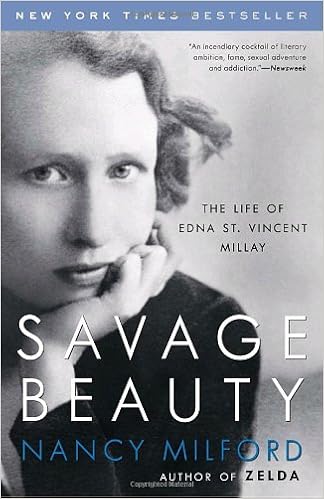
Book Look: Savage Beauty: The Life of Edna St. Vincent Millay, by Nancy Milford

Image result for savage beauty millay


Per the forward to this long bio, Milford’s the first to have been granted access to the poet Edna St. Vincent Millay’s private letters and journals, long held in keeping by her sister Norma. This helps explain why this narrative is so compelling: having access to the subject’s own journals and letters provides fascinating access to her internal as well as external life. However, this may also explain the frustrating limits of this narrative: basically, if an incident isn’t covered in the letters, it isn’t mentioned here – leading to a biography that feels weirdly limited and insular. Moreover, while letters and diary entries may be revealing, they’re not necessarily complete, and they’re not necessarily trustworthy. In this case, it’s necessary to remember that our subject, Millay, wasn’t just a poet – she was also an accomplished actress, an erratic diarist with a tendency to omit unpleasant events, and an expert manipulator (especially of men and older women) with a gift for self-delusion. At the end of 500 pages I guarantee you’ll know a lot more about Millay, her life, and her canon; just don’t expect to have gained much insight into the forces that likely played the greatest role in shaping her life and character, which (based on clues in this text) may have included abandonment issues, bipolar disorder, and childhood sexual trauma.

There’s way too much drama in Millay’s life to try to summarize here, from her oddly heartbreaking childhood to her wild, bohemian adulthood to her early death following increasingly dramatic hospitalizations and staggering drug use. What Milford seems intent upon us understanding is that, as worthy as Millay’s poetry may have been, her fame was also in large part indebted to her ability to create her own “cult of personality.” If it hadn’t been for the willingness of a succession of older women, dazzled by her talent and charm, to smooth her path to and through college; if it hadn’t been for a string of discarded lovers, enchanted by her beauty, intensity, and sexual precocity, to ensure her poems stayed constantly in the public eye; if it hadn’t been for her scores of fans, particularly “sexually liberated young women,” enthralled by her dramatic public readings, her risqué reputation, and her husky contralto voice, flocking to the stores to purchase her poetry – one wonders whether she would have become what she became: the first woman to win a Pulitzer Prize for poetry and the “voice of her era.” For if F. Scott Fitzgerald can be said to have given the “Jazz Age” its voice, then Millay can surely be said to have written the libretto.

Which brings me to the quirks of Milford as a narrator. She has the oddest habit of introducing new characters without any preamble and minimal biographical information, making it very difficult to figure out which characters are “minor” and which “major.” It was frustrating to constantly have to double back to re-read character introductions when the characters suddenly reappeared, 100 pages later, without any helpful reference or context. Even the minimal biographical information she provides sometimes comes chapters after the characters have been introduced, long after it would have been useful to have. Another issue I had was with Milford’s apparent resolve to present information without endeavoring to interpret it. In general I’m grateful when biographers eshew psychobabble – but isn’t there also something a little unhelpful (if not irresponsible) about presenting two fairly significant clues that Millay was the victim of childhood sexual trauma at the hands of one (or more) of her mother’s lovers with as much detachment as she brings to reprinting Millay’s endless letters about fashion? About as far as Milford goes is to acknowledge that when Millay starts using baby talk in her letters to her family, it’s “a bad sign” – though she coyly declines suggest what it’s a bad sign of.

On the other hand, you could argue that this approach, at the least, provides ample fodder for book club discussion! Some of the questions my group wrestled with (and that I’m still wrestling with): What was the root cause of Vincent’s sexual precocity – was it a Jazz Age thing? A poet thing? A Greenwich Village/bohemian thing? A symptom of a childhood sexual trauma? A desperate cry for attention/love? How did regularly society react to her many affairs with women and married men – or, what explains their failure to react? Did the babying she received at the hands of her husband Eugin truly protect her from her mistakes, or merely enable her to continue making them? Were her many illnesses real or psychosomatic? When did she begin using morphine, and what role did it play in hastening her nervous breakdowns? Or do Millay’s alternating episodes of mania and depression provide evidence that she was struggling with bipolar disorder? What exactly were her true feelings towards the mother she outwardly adored, but who in fact abandoned her daughters for long periods of time and seems, throughout this narrative, much more interested in being Vincent’s BFF than protecting her from harm? And finally, the biggest question of all: after reading this 500 page biography, why are we all struggling with the feeling that this narrative omits almost as much valuable insight as it includes?

9/06/2013

Most Romantic Lines From Literature


Hope others will enjoy this collection of swoon-worthy quotes from literature as much as I enjoyed compiling them!   Obviously there are thousands to choose from, so I've limited myself to classic literature and quotes that made my own heart give a little throb the first time I read them. 
  1. "Whatever our souls are made of, his and mine are the same.” - Catherine, Wuthering Heights (Emily Bronte)
  2. "If he loved you with all the power of his soul for a whole lifetime, he couldn't love you as much as I do in a single day." - Heathcliff, Wuthering Heights (Emily Bronte)
  3. "I pray one prayer--I repeat it till my tongue stiffens--Catherine Earnshaw, may you not rest as long as I am living; you said I killed you--haunt me, then! The murdered do haunt their murderers, I believe. I know that ghosts have wandered on earth. Be with me always--take any form--drive me mad! only do not leave me in this abyss, where I cannot find you! Oh, God! it is unutterable! I cannot live without my life! I cannot live without my soul!" - Heathcliff, Wuthering Heights (Emily Bronte)
  4. "A solemn passion is conceived in my heart; it leans to you, draws you to my centre and spring of life, wraps my existence about you–and, kindling in pure, powerful flame, fuses you and me in one.” - Mr. Rochester, Jane Eyre (Charlotte Bronte)
  5. "You should be kissed, and often, and by someone who knows how.” - Rhett Butler, Gone With The Wind (Margaret Mitchell)
  6. “You pierce my soul. I am half agony, half hope. Tell me not that I am too late, that such precious feelings are gone for ever. I offer myself to you again with a heart even more your own than when you almost broke it, eight years and a half ago. Dare not say that man forgets sooner than woman, that his love has an earlier death. I have loved none but you." - Capt. Wentworth, Persuasion (Jane Austen)
  7. "If you live to be a hundred, I want to live to be a hundred minus one day, so I never have to live without you." - Winnie the Pooh (A.A. Milne)
  8. But our love it was stronger by far than the love/Of those who were older than we-/Of many far wiser than we-/And neither the angels in heaven above,/Nor the demons down under the sea,/Can ever dissever my soul from the soul/Of the beautiful Annabel Lee. - Annabelle Lee (Edgar Allen Poe)
  9. "As you wish," Wesley, Princess Bride (William Goldman)
  10.  "No matter where you go. I will find you. No matter how long it takes, no matter how far, I will find you. " - Hawkeye, The Last of the Mohicans (James Fenimore Cooper)
  11. "My bounty is as boundless as the sea,/My love as deep; the more I give to thee,/The more I have, for both are infinite." - Juliet, Romeo & Juliet, Shakespeare
  12. "What did my arms do before they held you?" -Sylvia Plath
  13. "When I first met her, I knew in a moment I would have to spend the next few days re-arranging my mind so there'd be room for her to stay"- Gatsby, The Great Gatsby (F. Scott Fitzgerald)
  14. "Strephon kissed me in the spring,/Robin in the fall,/But Colin only looked at me/And never kissed at all.//Strephon's kiss was lost in jest,/Robin's lost in play,/But the kiss in Colin's eyes/Haunts me night and day." - Sara Teasdale

5/31/2010

Greatest Poems About War


Poetry is meant to evoke mood and emotion, which is perhaps why - next to love - so many of the most eloquent poems are about war.  In honor of Memorial Day, I have compiled the following list of some of the most evocative poems about war, and war's aftermath.
  1. In Flanders Fields, Lt. Col. John McCrae.  If there's a poem that expresses more succinctly, or more viscerally, the simultaneous tragedy and nobility of war, I've never encountered it.  This poem is responsible for the indelible association of poppies with celebrations of remembrance, and also  responsible for some of the most moving imagery in modern poetry:  Take up our quarrel with the foe:/ To you from failing hands we throw/ The torch; be yours to hold it high./ If ye break faith with us who die/ We shall not sleep, though poppies grow/ In Flanders fields.
  2. Battle Hymn of the Republic, Julia Ward Howe.  Since time immemorial soldiers have derived comfort from the conviction that they were fighting on the side of God (or gods, as the case may be).  To my mind, no poem expresses the power and glory of this conviction better that this hymn composed during the American Civil War.  While I love the imagery of I have seen Him in the watch-fires of a hundred circling camps, and the glorious conviction of He hath loosed the fateful lightning of His terrible swift sword:, it's a particular line in the final verse of the hymn that makes me want to actually take up arms and go off to join the fight: As He died to make men holy, let us die to make men free,/ While God is marching on! 
  3. Destruction of Sennacherib, George Gordon Byron.  Heard this for the first time when a college history teacher of mine read it aloud, and the opening couplet - The Assyrian came down like the wolf on the fold,/ And his cohorts were gleaming in purple and gold; - still has the power to raise goosebumps on my arms.  What a simile! What imagery!  But the poem may be better known for the more sober lines that follow, a reminder of the ghastly cost of war: And there lay the rider distorted and pale,/  With the dew on his brow, and the rust on his mail:/ And the tents were all silent, the banners alone,/ The lances unlifted, the trumpet unblown.
  4. Charge of the Light Brigade, Alfred, Lord Tennyson.  Theirs not to make reply,/  Theirs not to reason why,/  Theirs but to do and die:/  Into the valley of Death.  Rarely has any poet done a finer job of capturing in verse both the courage and horror of soldiers staltwartly marching into a battle against impossible odds, fully aware that they will not survive.
  5. The Soldier, Rupert Brooke.  Though Brooke's "war sonnets," composed in the early years of the first World War, are considered by some to be naively patriotic, that's precisely what I love about them.  Whatever your politics, surely we can all get behind the notion that warriors deserve to believe that they are risking their lives for something that is worth dying for, and no one does it better than Rupert, as the opening lines of this verse attest: If I should die, think only this of me:/ That there's some corner of a foreign field/ That is for ever England.
  6. Paul Revere's Ride, Henry Wadsworth Longfellow.  Next to most of the verses here, Longfellow's contribution must appear a bit simplistic and idealized.  But given that the events retold have themselves become simplified and idealized, you could argue that Longfellow perfectly captures the essence of the famous events leading up to the first battle of the American War for Independence.  That was all! And yet, through the gloom and the light,/ The fate of a nation was riding that night;/ And the spark struck out by that steed, in his flight,/ Kindled the land into flame with its heat.
  7. Dulce et Decorum Est, Wilfred Owen.  Unlike Rupert Brooke, Owen was under no illusions about the glories of the first World War.  This poem, in which he describes the gruesome death of a soldier by poison gas (If you could hear, at every jolt, the blood/ Come gargling from the froth-corrupted lungs), is as brutally realistic - and horrific - as Brooke's poems are sentimental.  The title, which translates (roughly) as "It is good and right to die for your country," is entirely ironic. 
  8. Gunga Din, Rudyard Kipling.  Also from the "realism school of war poetry" comes this tale of a native water boy who gives his life to save a British officer.  Though the poem is perhaps best known for it's final lines (Tho' I've belted you an' flayed you,/  By the livin' Gawd that made you,/ You're a better man than I am, Gunga Din!), the poem also stands as a testiment to the courage of all the men who, despite being despised for their race, fought and died alongside the men who disdained them.
  9. The Iliad, Homer.  A story so thrilling - and themes so immortal - that two thousand years later it's still as relevant as the day Homer first set the events of the Trojan War to verse.
  10. Gettysburg Address, Abraham Lincoln.  Not technically considered a poem, but anyone who's thrilled to the alliteration of four score and seven years ago, or felt their hearts break upon the dolorous vowels of we cannot dedicate, we cannot consecrate, we cannot hallow this ground, or felt their pulse quicken at the rising momentum of of the people, by the people, for the people, intuitively comprehends that the 144 words of the Gettysburg Address are poetry at its finest and most effecting.

5/25/2010

Inspirational Poems


If you are looking for inspiration, poetry offers more bang for the buck than a Norman Vincent Peale seminar. Just ask Abraham Lincoln, who made glorious use of alliteration, consonance and assonance in his Gettysburg Address ("Four score and seven years ago ..." - don't you love those dolorious oooor sounds offset by the sibilant s's?). Or Martin Luther King Jr., who made history-altering use of repetition ("I have a dream!"). Or Shakespeare's fictional Henry V, whose rousing speech combining repetition and alliteration ("We few, we happy few, we band of brothers ...") coaxed the ridiculously outnumbered and overmatched English forces onto the field at Agincourt.

I once read a book on brain science that would seem to explain our almost primitive emotional response to the repetition of sounds and phrases.  Turns out our brain's ability to recognize such patterns was the foundation upon which we evolved language.  And in its more primitive form, we still celebrate our visceral attraction to patterns of sound, rhythm, and rhyme through our love of poetry, music, and dance.  (What other explanation could there possibly be for the success of Sir Mix-a-lot's Baby Got Back?)

All of which is my way of introducing the notion that when you need a boost of inspiration, confidence, or courage, nothing serves like a few measures of well-crafted verse.  Below are some favorite examples I've collected over the years.  When I need a little motivation, encouragement, or courage to make a change in my life, these are some of the standards that I turn to.
  1. The Road Less Travelled, Robert Frost.  Is there anyone in the western world that isn't familiar with this poem?  Well, there's a reason.  There comes a time in everyone's life when we contemplate choosing a "path less travelled" - pursuing a dream, for instance - and this poem feels like a beloved grandfather patting you on the back and telling you: "Go ahead, child: you won't regret it." Pure, uncomplicated reassurance.
  2. If, Rudyard Kipling.  You don't have to be a boy to be inspired by this sagacious advice from a father to his son on the subject of how to live a worthwhile life.  This paeon to the virtues of hard work, tolerance, tenacity, modesty, and moral courage reminds us all that what makes us great isn't the things that happen to us, but how we choose to react to the things that happen to us. 
  3. Phenomenal Woman, Maya Angelou.  With apologies to all you phenomenal men out there (hey, I included If for you), this celebration of femininity is just the ticket for women who feel insecure about the way they look or interact with the world, reminding us that while beauty may be sexy, confidence is a thousand times sexier.
  4. Not In Vain, Emily Dickinson.  For all those people who have laid in bed in the morning looking for a reason to get up, this sweet little verse reminds us that even our smallest actions may have worthy consequences. (Just in case you've somehow missed any of the 1000 showings of It's A Wonderful Life on television over the years.)
  5. Be Strong, Maltbie Davenport Babcock.  If you aren't in the mood for Emily Dickinson's coddling, let Ms. Babcock whip you into shape with this fierce and unforgiving call to action.  She isn't going to let you forget that "It matters not how deep entrenched the wrong,/ How hard the battle goes, the day, how long./ Faint not, fight on!"
  6. Invictus, William Earnest Henry.  Can't be coincidence that this is also the title of a movie that explores the struggle over apartheid in South Africa.  My head is bloody, but unbowed ... these words from the poem could be written on Nelson Mandela's memorial one day.  But my favorite lines comes later, because there comes a time when all of us need to be reminded: I am the master of my fate:/ I am the captain of my soul.

5/20/2010

12 Famous Tragic/ Melodramatic Poems


The term melodrama refers to a dramatic work which exaggerates plot and characters in order to appeal to the emotions.  For this reason, melodramatic poetry tends to be especially beloved by teenagers and women in the throes of bad romantic relationships.  This is somewhat unfair, however, as most of the poems listed below are wholly satisfying as both stories and examples of verse.  Read them and see if you don't agree.

  1. The Wreck of the Hesperus, Henry Wadsworth Longfellow.  This thoroughly melodramatic narrative poem relates the story of a ship wrecked in a storm.  Alas, the skipper of the vessel is too proud to heed the warnings of the Crusty Old Sailor, who sagely advises him to "Put into yonder port/for I fear a hurricane."  Not only does the skipper laugh scornfully, but he decides to take his beautiful young daughter along as well.  (Hubris, anyone?)  Note to skipper: Everyone knows you ignore the advice of Crusty Old Sailors at your peril! 
  2. The Highwayman, Alfred Noyes.  You have to appreciate the way-over-the-top pathos of this tale of a lass awaiting the return of her dashing lover who, alas, also happens to be a ruthless highwayman with a price on his head.  (Some women just can't resist the bad boys, can they?)  Every time I read the poem I keep hoping that she's going to shout "Hey, the soldiers are coming to get you!" (or words to that effect) rather than killing herself.  But she never does. 
  3. Annabelle Lee, Edgar Allen Poe.  This deservedly famous poem is so romantic and tragic that has been known to reduce whole middle school classes to sniffling tears.  Supposedly a semi-autobiographic account of the untimely death of Poe's own young wife of tuberculosis, the story may draw you in, but it's the gorgeous language (that assonance! that consonance! that alliteration!) that will keep you reaching for the box of tissues.   
  4. O Captain! My Captain!, Walt Whitman. Yes, it's that poem from the movie Dead Poet's Society.  More to the point, it's a tribute to Abraham Lincoln penned shortly after his assassination, and it works as an eloquently affecting paeon or homage to anyone who you have admired or looked up to. I dare you to read it aloud and not get at least a little teary. 
  5. The Ballad of John Henry, author unknown.  Some say John Henry's a folktale, others argue that the legend stems from the feats of a real man, possibly a slave who worked laying down railroad track in the late 1800s.  Whatever the origin, the basic story is always the same, as is the outcome: John Henry challenges a steam drill to a contest, wins, but dies of exhaustion promptly afterwards, his life cut short by his superhuman effort.  One of a long, long lineage of literary ludditia (think Terminator I, II, III and/or IV) devoted to the contention that technology is soulless and evil. 
  6. Rime of the Ancient Mariner, Samuel Taylor Coleridge. "Water, water, everywhere/Nor any drop to drink." Before it became a metaphor for pretty much everything, this was one of a great many affecting lines in this tale of ship doomed to slow death.  And in case you weren't paying attention earlier: always heed the advice of Crusty Old Sailors!
  7. The Ballad of Reading Gaol, Oscar Wilde.  Oscar Wilde took as his inspiration for this long, georgeously tragic ode the true story of a man who was hanged for the murder of his wife.  Many, many dazzling stanzas, the most famous of which is surely Wilde's haunting lament, repeated several times: "Yet each man kills the thing he loves,/By each let this be heard,/Some do it with a bitter look,/Some with a flattering word,/The coward does it with a kiss,/The brave man with a sword."
  8. Lady of Shalott, Alfred, Lord Tennyson. "Out flew the web and floated wide;/The mirror cracked from side to side;/'The curse has come upon me!' cried/The Lady of Shalott."  Making the eponymous Lady of Shallot neither the first nor the last maiden to be lured to her doom by the charms of that chivalric rogue, Sir Lancelot.  (Some men just can't keep it in their fauld, if you know what I mean ....)
  9. Charge of the Light Brigade, Alfred Lord Tennyson. If you like your tragedy served up with a side of valor, you can't do better than this ode to the disastrous charge of British cavalry led by Lord Cardigan against Russian forces during the Battle of Balaclava on 25 October 1854 in the Crimean War: "Theirs not to make reply;/Theirs not reason why;/Theirs but to do or die:/Into the valley of Death."  (It's the "into the valley of Death" part that chokes me up every time.)
  10. The Raven, Edgar Allen Poe.  On the other hand, if you like your tragedy served up with a side of creepy, Poe's The Raven is just the ticket, combining a dark and story night, the recent death of the narrator's true love, a perseverating raven, and a meter/rhyme scheme that would make a rap star swoon into one truly eerie tale.  Definitely don't read this one in the dark.
  11. The Wreck of the Edmund Fitzgerald, Gordon Lightfoot.  Doesn't get much more tragic or melodramatic than this true tale of the sinking of the freighter Edmund Fitzgerald in Lake Superior.  By all means read the lyrics, but you'll want to listen to the song that goes with the lyrics to fully appreciate the gleefully unapologetic pathos of the tale.

  12. Bonnie Barbara Allen, author unknown. And finally, the grand-daddy of them all, a ballad that for the past 300 years has reminded us to be careful what we say to the people we love, lest they are taken away from us before we have a chance to repent of the cruel things we say.  All the more tragic and melodramatic because it's true.

5/02/2010

Greatest Poems About Love


Does anyone else get overwhelmed by the courtly, hyperbolic nature of most love poetry?  I'm reminded of a scene in Shakespeare in Love, in which Elizabeth I scornfully suggests that no poet can ever capture the "truth and essence" of love.  Have to agree with Liz on that one ... altogether too many so-called "love poems" elevate the beloved to such absurd levels of beauty, virtue, and perfection that the result may make for beautiful verse but bears little relevance to actual people or the actual "truth and essence of love".

Happily, Elizabeth I ends up recanting her skepticism, and the poems listed below have gone a long way towards causing me to recant mine.  This list may not include some of the most famous poetry about love, but it does contain some of the most sincere poetry about love. 
  1. My Love is Like a Red, Red Rose, Robert Burns.  I love this poem for its artlessness; you don't have to have an advanced degreee in literature (though an understanding of colloquial Scottish language and spelling is useful) to understand that the narrator intends to be faithful until the seas go dry, until rocks melt in the sun, until the end of time. My heart especially flutters at the part where he vows to come again, "tho' it ware ten thousand mile." It would take a heartless woman indeed not to be moved by so simple yet genuine an appeal.
  2. How Do I Love Thee (aka Sonnets from the Portuguese, 43), Elizabeth Barrett Browning. Since the 1800s people have swooned over the romantic story of how sickly, middle-aged Elizabeth Barrett was swept off her feet by the devotion of the dashing, younger Robert Browning.  Perhaps it takes a great love story to produce great love poetry like this glorious verse.  "I love thee with the breath/ smiles, tears of all my life!" Barrett says, and  I can't imagine a sentence that does a better job of expressing the joyful abandon of pledging your heart and life to another soul. 
  3. My Mistress's Eyes (aka Sonnet 130), William Shakespeare.  The charm of this timeless sonnet is the way that it dares to mock the inherent hyperbole of "courtly love."  While admitting his lover's eyes are nothing like the sun, that her skin is dun rather than the white of snow, and that her lips bear no resemblence to the rosy red of coral, "... yet, by heaven, I think my love as rare/ As any she belied with false compare."  As novel as it must to be have one's cheeks compared to roses, Will shrewdly divines that true love isn't about flattery, but about understanding. 
  4. The Great Lover, Rupert Brooke.  Though the first couple of stanzas of this poem can be a bit dense, they're worth wading through to get to the glorious stanzas in the middle, where Rupert begins to list the things he has loved:  "White plates and cups, clean-gleaming,/ Ringed with blue lines; and feathery, faery dust;/ Wet roofs, beneath the lamp-light; the strong crust/ Of friendly bread; and many-tasting food;/ Rainbows; and the blue bitter smoke of wood;/ And radiant raindrops couching in cool flowers;/ And flowers themselves, that sway through sunny hours,/ Dreaming of moths that drink them under the moon;/ Then, the cool kindliness of sheets, that soon/ Smooth away trouble; and the rough male kiss/ Of blankets; grainy wood; live hair that is/ Shining and free; blue-massing clouds; the keen/ Unpassioned beauty of a great machine;/ The benison of hot water; furs to touch;/ The good smell of old clothes; and other such/ The comfortable smell of friendly fingers,/ Hair's fragrance, and the musty reek that lingers/ About dead leaves and last year's ferns..."  Only a man who possesses a true understanding of love could compose so passionate a list!
  5. The Passionate Shepherd to His Love, Christopher Marlowe.  This one used to make me a little self-conscious, because everything to do with shepherds and shepherding has become so irrevocably associated with the silliest sort of pastoral romanticism.  But even Marie Antoinette hasn't been able to entirely stamp out my affection for this wonderfully earnest little poem in which the narrator pleas: "Come live with me and be my love,/ and we will all the pleasures prove ...".  Simply the best marriage proposal ever.
  6. Let Me Not to The Marriage of True Minds (aka Sonnet 116), William Shakespeare.  Another entry from the Bard, who must have known a thing or two about love in order to pen these lines about the unwavering nature of true love.  What are our traditional Christian wedding vows ("... for better or for worse, for richer, for poorer, in sickness and in health," etc.), after all, but a dramatically less elegant paraphrasing of the Bard's immortal sentiment: "...love is not love/ Which alters when it alteration finds"?
  7. Annabelle Lee, Edgar Allen Poe.  What Romeo and Juliet is to drama, Annabelle Lee is to poetry ... truly, the "truth and essence of love" distilled, intensified, and dispensed straight from the soul of the poet.  Yes, Edgar does engage in a fair amount of hyperbole ("The angels, not half so happy in heaven,/ Went envying her and me"), but you don't have possess an advanced knowledge the details of the tragic death of Poe's own beloved to appreciate that there's absolutely nothing extravagant or false about the grief that drips from every line of this devastating lament.