
So, clearly, I'm still on my Sherlock Holmes kick. Have decided to assemble all my favorite Great Detective quotes in one place. Most of them fall under the heading of "general life wisdom". Many of them I employ on a daily basis in my science classroom. But sometimes they're specific to the canon - I just love them for what they are!
- "When you have eliminated the impossible, whatever remains, however improbable, must be the truth." - A Sign of Four
- "Life is infinitely stranger than anything the mind of man could invent." - A Case of Identity
- "Now is the dramatic moment of fate, when you hear the step upon the stair which is walking into your life, and you know not whether for good or ill." - The Hound of the Baskervilles
- "The chief proof of man's greatness lies in his perception of his own smallness." - The Sign of Four
- "There is nothing more deceptive than an obvious fact." - The Boscombe Valley Mystery
- "It is a capital mistake to theorize before one has data. Insensibly one begins to twist facts to suit theories, instead of theories to suit facts." - A Scandal in Bohemia
- "You see, but you do not observe." - A Scandal in Bohemia
- "The game is afoot!" - The Adventure of the Abbey Grange
- "When a doctor goes wrong, he is the first of criminals. He has the nerve and he has the knowledge." - The Adventure of the Speckled Band
- "You can tell an old master by the sweep of his brush. I can tell a Moriarty when I see one." - The Valley of Fear
- "Mr. Holmes - they were the footprints of a gigantic hound!" - The Hound of the Baskervilles
- "But Mr. Holmes, the dog did nothing in the nighttime." - "That is the curious incident!" - Silver Blaze
- "Data, data, data! ... I cannot make bricks without clay." - The Adventure of the Copper Beaches
- "My mind is like an engine tearing itself to pieces because it is not connected up to the work for which it was intended." - The Man With the Twisted Lip
- "My mind rebels at stagnation." - The Sign of Four
- "Mediocrity knows nothing higher than itself." - The Valley of Fear
- "Crime is common. Logic is rare." - The Adventure of the Copper Beaches
- "I consider that a man's brain originally is like a little empty attic, and you have to stock it with such furniture as you choose. A fool takes in all the lumber of every sort that he comes across, so that the knowledge which might be useful to him gets crowded out, or at best is jumbled up with a lot of other things, so that he has a difficulty in laying his hands upon it." - A Study in Scarlet
- "To a great mind, nothing is little." - A Study in Scarlet
- "We balance probabilities and choose the most likely. It is the scientific use of the imagination." - The Hound of the Baskervilles
- "Come at once if convenient - if inconvenient, come all the same." - The Adventure of the Creeping Man
- "I followed you." - "I saw no one." - "That is what you may expect to see when I follow you." - The Adventure of the Devil's Foot
- "He [Moriarty] sits motionless, like a spider in the centre of its web, but that web has a thousand radiations, and he knows well every quiver of each of them." - The Final Problem
- "Avoid the moor in those hours of darkness when the powers of evil are exalted." - The Hound of the Baskervilles
- "Education never ends, Watson. It is a series of lessons with the greatest for the last." - The Red Circle

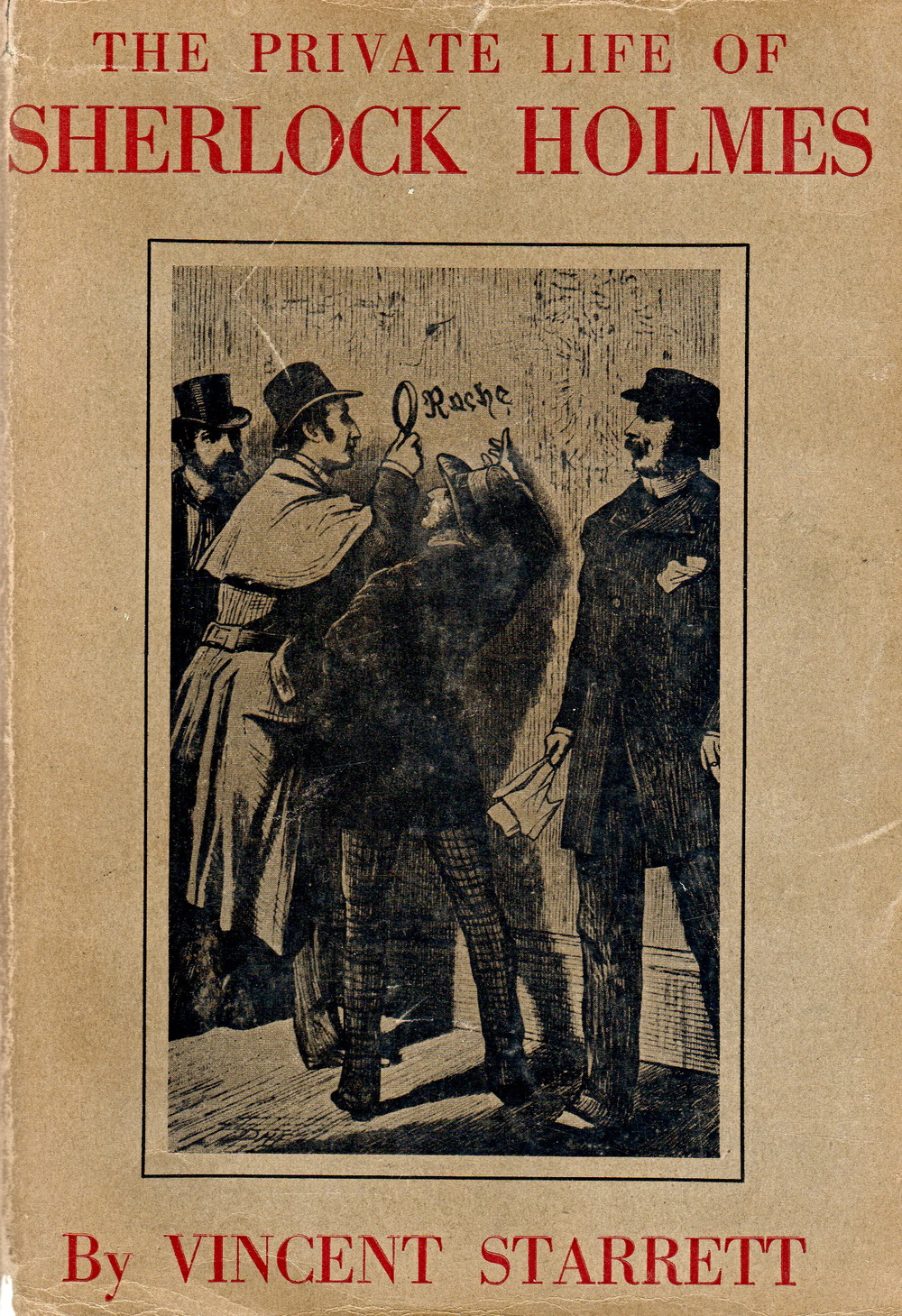

Turns out I'm not the only one wondering! The author, E.J. Wagner, combines his skills as a historian and his credentials as a Holmes fan to map the Sherlock Holmes stories against actual Victorian crimefighting techniques.
Devoting a chapter each to poisons, fingerprints, footprints, handwriting evidence, insect evidence, disguise, ballistics, dust/fiber analysis, blood evidence, how crime scenes were processed, and the science of autopsies, Wallace describes the methods that were actually being utilized at the time, gives examples of each in the Holmes canon, and then regales the reader with scores of real-life cases from the Victorian era in which the techniques were employed.
Though he's writing about science, Wagner's prose is breezy, his tone light, and his scientific descriptions highly accessible. Nor is a knowledge of the Holmes stories a prerequisite, as the author is diligent in ensuring that all quotes from the stories are accompanied by a sufficiently detailed description of context.
There's really something for everyone here. Historians will appreciate the opportunity to learn more about not-often-addressed aspects of the Victorian era. Fans of true & fictional crime will delight in the author's engrossing tales of notorious Victorian crimes (a combination of the usual "Victorian greatest hits of crime" - Lizzie Bordon, Jack the Ripper, Madame Lafarge, Dr. Crippen, etc. - enhanced by scores of lesser known but equally engrossing tales). And Sherlockians will relish the opportunity to learn more about how police methods influenced the Holmes tales ... and, even more fascinating, how the Holmes tales influenced police methods.
This is one book that deserves more attention than it has apparently gotten. Highly recommended!