Showing posts with label real/strong women. Show all posts

1/29/2022

10 Things Large Women Wish Clothes Designers Understood


1. Being large doesn’t mean we don’t have taste. PLEASE, no more garish fabrics with huge hibiscus flowers or other prints that should never have left the mumu factory! But that doesn’t mean we want to wear solid colors all our lives either.  Just use the same prints you use for all the other women.

2. We realize that leggings are cheap and easy to manufacture in a variety of sizes, but they do NOT flatter the legs of larger women. Displaying small ankles just highlights the size of our calves and thighs. Bootleg cut pants, in contrast, make legs look thinner by sandwiching them between wider lengths of fabric at the ankles and waist

3. So why do we buy leggings? Two words: thigh rub. It’s a major discomfort for large women, especially in shorts.  Please give us more bike-type shorts – snug without clinging but in slick fabrics that move freely as we walk rather than catching and rubbing. (And add some pockets while you’re at it – overweight women are tired of being cheated of pockets!)

4. Bathing suits. Large women don’t like them. Thigh rub is one reason. Having to wrestle our way out of wet one piece bathing suits just to go to the bathroom is another. The fact that many designs feature ruffles that stop right at the widest part of our booties is yet another.  We need two-piece bathing suits that come with shorts rather than panties, and longer tops that drape all the way over our booties.  Think old-fashioned wading dresses, but in cuter fabrics and more sexy designs

5. What’s the deal with sweaters? Why are you always trying to sell us long, baggy sweaters? Large women run hot – the last thing we want to be doing is wearing extra layers of wool. If you want to sell us extra layers, consider thinner fabrics

6. While I appreciate irony, there’s nothing more frustrating than shopping in the big/tall section only to discover that the shirts are shorter than those in every other department. While some women have shaped booties that deserve to be shown off, a lot of us don’t; we need shirts in a range of lengths, from short to extra long

7. And speaking of upsizing shirt lengths, please stop upsizing the length of the arms as well.  We’re ordering longer shirts not because we’re giantesses, but because we want some fabric concealing our tummies and booties. Our arms don't need to be flopping around in 6” of extra, unwanted sleeve.

8. Design isn’t everything – fabrics matter too.  Cute tunics in jersey fabrics are useless, because they catch on our pants and look terrible. Ditto wool and cheap cotton. A little spandex goes a long way towards helping our clothes hang in a flattering way.

9. Speaking of which, could we get some recognition that our booties are often wider than our shoulders? Stovepipe designs are made for people without curves.  Shirts that flair at the bottom give our booties room to move.

10. Large women deserve cute shoes that don’t collapse under our weight! When designing wider sizes, we need you to build in more structural supports – and make the toe openings wider on sandals, while you’re at it!

1/11/2017

10 Awesomely Ambiguous Pulp Magazine Covers


"WTF, guys?"
How I feel when people interrupt me when I'm trying to read.

"Hey, sweetie, I think he just stuck a knife through your hand! Here, let me get a light ...
OMG, has your hand been that deformed the whole time?"


"I'll give you  a hand a second, darling - just as soon as I put this vase back where it belongs."


"This tie is constantly obstructing my aim! I hate this mobster dress code!"


"I SERIOUSLY need to reconsider posting my dating profile on MobThrob.com"


"Like any moderately competent female, you'll notice I've taken the time to
don high heels, do my hair, and color-coordinate my harness with my dress.
Honestly, I don't know why men always insist on making this look so hard."


"I could just go and get a bandaid for this little scratch on my head, but instead
I think I'll lie here and painstakingly spell out the name of my attacker in pearls."


"Apparently you missed my performance in the talent portion of the competition,
you asshole, because for me 'fighting crime' ain't just some words on a sash!"


"Okay, guys, I'm depending on you to hold off the anti-vax, flat earth, climate change denying wackos long enough for me to publish my validated scientific findings in a peer-reviewed journal!" 


"That's it - I'm never working at a VA hospital again!"


9/19/2016

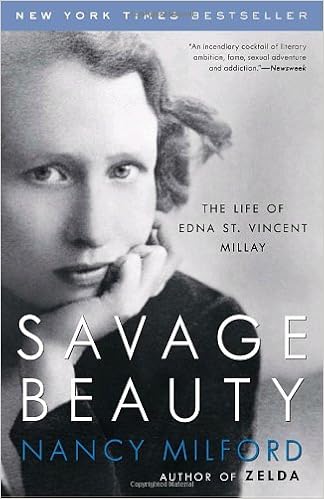
Book Look: Savage Beauty: The Life of Edna St. Vincent Millay, by Nancy Milford

Image result for savage beauty millay


Per the forward to this long bio, Milford’s the first to have been granted access to the poet Edna St. Vincent Millay’s private letters and journals, long held in keeping by her sister Norma. This helps explain why this narrative is so compelling: having access to the subject’s own journals and letters provides fascinating access to her internal as well as external life. However, this may also explain the frustrating limits of this narrative: basically, if an incident isn’t covered in the letters, it isn’t mentioned here – leading to a biography that feels weirdly limited and insular. Moreover, while letters and diary entries may be revealing, they’re not necessarily complete, and they’re not necessarily trustworthy. In this case, it’s necessary to remember that our subject, Millay, wasn’t just a poet – she was also an accomplished actress, an erratic diarist with a tendency to omit unpleasant events, and an expert manipulator (especially of men and older women) with a gift for self-delusion. At the end of 500 pages I guarantee you’ll know a lot more about Millay, her life, and her canon; just don’t expect to have gained much insight into the forces that likely played the greatest role in shaping her life and character, which (based on clues in this text) may have included abandonment issues, bipolar disorder, and childhood sexual trauma.

There’s way too much drama in Millay’s life to try to summarize here, from her oddly heartbreaking childhood to her wild, bohemian adulthood to her early death following increasingly dramatic hospitalizations and staggering drug use. What Milford seems intent upon us understanding is that, as worthy as Millay’s poetry may have been, her fame was also in large part indebted to her ability to create her own “cult of personality.” If it hadn’t been for the willingness of a succession of older women, dazzled by her talent and charm, to smooth her path to and through college; if it hadn’t been for a string of discarded lovers, enchanted by her beauty, intensity, and sexual precocity, to ensure her poems stayed constantly in the public eye; if it hadn’t been for her scores of fans, particularly “sexually liberated young women,” enthralled by her dramatic public readings, her risqué reputation, and her husky contralto voice, flocking to the stores to purchase her poetry – one wonders whether she would have become what she became: the first woman to win a Pulitzer Prize for poetry and the “voice of her era.” For if F. Scott Fitzgerald can be said to have given the “Jazz Age” its voice, then Millay can surely be said to have written the libretto.

Which brings me to the quirks of Milford as a narrator. She has the oddest habit of introducing new characters without any preamble and minimal biographical information, making it very difficult to figure out which characters are “minor” and which “major.” It was frustrating to constantly have to double back to re-read character introductions when the characters suddenly reappeared, 100 pages later, without any helpful reference or context. Even the minimal biographical information she provides sometimes comes chapters after the characters have been introduced, long after it would have been useful to have. Another issue I had was with Milford’s apparent resolve to present information without endeavoring to interpret it. In general I’m grateful when biographers eshew psychobabble – but isn’t there also something a little unhelpful (if not irresponsible) about presenting two fairly significant clues that Millay was the victim of childhood sexual trauma at the hands of one (or more) of her mother’s lovers with as much detachment as she brings to reprinting Millay’s endless letters about fashion? About as far as Milford goes is to acknowledge that when Millay starts using baby talk in her letters to her family, it’s “a bad sign” – though she coyly declines suggest what it’s a bad sign of.

On the other hand, you could argue that this approach, at the least, provides ample fodder for book club discussion! Some of the questions my group wrestled with (and that I’m still wrestling with): What was the root cause of Vincent’s sexual precocity – was it a Jazz Age thing? A poet thing? A Greenwich Village/bohemian thing? A symptom of a childhood sexual trauma? A desperate cry for attention/love? How did regularly society react to her many affairs with women and married men – or, what explains their failure to react? Did the babying she received at the hands of her husband Eugin truly protect her from her mistakes, or merely enable her to continue making them? Were her many illnesses real or psychosomatic? When did she begin using morphine, and what role did it play in hastening her nervous breakdowns? Or do Millay’s alternating episodes of mania and depression provide evidence that she was struggling with bipolar disorder? What exactly were her true feelings towards the mother she outwardly adored, but who in fact abandoned her daughters for long periods of time and seems, throughout this narrative, much more interested in being Vincent’s BFF than protecting her from harm? And finally, the biggest question of all: after reading this 500 page biography, why are we all struggling with the feeling that this narrative omits almost as much valuable insight as it includes?

2/16/2016

Book Look: Troubled Daughters, Twisted Wives, edited by Sarah Weinman


As others have said, this collection of 14 stories is meant to shed light on a largely forgotten literary genre, so-called "domestic mysteries" - stories that draw their suspense from the uniquely strained and fraught interactions that occur within families. No gumshoes (a la Hammett), no feisty elderly detectives (a la Christie) - instead, Weinman's female authors gives us mentally disturbed nannies (Patricia Highsmith's "The Heroine"), desperate widows (Nedra Tyre's "A Nice Place to Stay"), and spoiled daughters (Shirley Jackson's "Louisa, Please Come Home"); women tormented by greed (Miriam Allen Deford's "Mortmain"), by jealousy (Vera Caspary's "Sugar and Spice"), and by Terrible Secrets (Barbara Callahan's "Lavendar Lady"); competent women gone wrong (Helen Nielsen's "Don't Sit Under the Apple Tree"; Joyce Harrington's "The Purple Shroud"), competent women sacrificing themselves for their families (Elisabeth Sanxay Holding's "The Stranger in the Car"), and competent women forced to sacrifice their families (Charlotte Armstrong's "The Splintered Monday"); lucky women (Dorothy Hughes's "Everybody Needs a Mink"), devious spinsters (Celia Fremlin's "A Case of Maximum Need"), and creepy children (Dorothy Davis's "Lost Generation"; Margaret Millar's "The People Across the Canyon").

As others have noted in their reviews, Weinman's introductions to each story do achieve the dubious distinction of simultaneously adding little useful info about the authors while incorporating spoilers that manage to rob many of the stories of their surprise. I'm inclined to forgive her the former, because - unlike their male colleagues - many of these women lived their lives in domestic rather than public arenas, making it hard to ferret out revealing biographical detail. However, there's really no excuse for the spoilers. If it's not too late, you may wish to give these introductions a miss.

Some of the stories are more imaginative then others, some more suspenseful than others, but all are competently written and diverting in their "domestic" way. While they may not exude melodramatic pulpiness, they are nevertheless chilling, perhaps precisely because the crimes they describe are domestic, and therefore feel a little more "close to home" than most of us would prefer our crime fiction to be.

12/19/2015

Book Look: Their Eyes Were Watching God, by Zora Neale Hurston


Admit I spent years unfairly biased against this book because so many people told me I should read this for its literary significance - Harlem Renaissance, New Negro Movement, etc. If only they'd told me I should read it because it's a moving and gorgeously written narrative, perhaps I wouldn't have waited so long! For those of you who many be in the same boat, let me allay your fears: this isn't a militant polemic against racism, nor the self-conscious, bloated "trophy novel" of a literary giant, nor the product of a specific time and ethos ... this is just really good storytelling, ageless and affecting in all the ways good storytelling should be.

This story narrates the life of Janie, an African-American woman growing up in Florida in the early 20th century. Yes, it was an era when racism was rife, and racism shapes the paths of her life in a thousand explicit and implicit ways, but this isn't primarily a story about racism: it's about a woman finding the courage to pursue what makes her happy, even as social norms and customs work actively to thwart her. In Janie's case, all she wants is not to have to pretend to be something she's not. Discarding husbands along the way, she finally finds happiness with a man years younger than herself - a fitting match(at last) for her young soul. In this era of modern, self-realized feminism, her patient acceptance of unhappiness, exploitation, and abuse may grate, but I believe Hurston is doing no more than painting Janie's story with the colors of her own life and times.

At the time it was published, I gather this book was not well received by Hurston's Harlem peers. I see their point (or I think I see it) - many of the secondary characters in the tale seem plucked straight out of a "common black stereotypes" casting call. There's her second husband, the Carpetbagger, fast-talking and slick and not above exploiting his fellow African-Americans; her best friend, the Patient Black Woman selflessly putting everyone else's happiness before her own; her third husband, a happy-go-lucky Mr. Bojangles; and a whole posses of straw-chewing, tall-tale-telling Old Black Men gathered wherever there's a porch and a checkerboard to host them. Again, I think this is just Hurston painting with the palette she knows, bravely (much like her heroine Janie) writing what made her happy rather than what her peers thought she ought to be writing.

Another criticism I've heard of the book is that Hurston's use of dialect can make this a slow read. For that reason I deliberately listened to it as an audiobook, narrated by actress/poet/journalist/civil rights activist Ruby Dee. Through her interpretation, any barriers between the reader and the language quickly melts away in a flood of appreciation for the uniquely authentic and evocative speech patterns and lyric metaphorical allusions employed by Hurston's rich and complex subculture. Seriously, some of the figurative language is so stunningly expressive, at times I had to stop reading and just pause to appreciate it.

As for that title, "Their Eyes Were Watching God" ... I suppose you could interpret it a lot of ways. Based on the context in which it is used in the story, though, I think it's meant to communicate the profound fragility of the lives these characters lead. None of us control our destiny, but surely this is even more profoundly true of African-Americans in mid-20th century U.S. Characters like Janie and Teacake may possess internal strength, but each of them accepts without question that they are creatures of fickle and unjust fate. What, then, to do, but embrace the moments of happiness God grants them, understanding that at any time - for reasons they will never be able to predict, control or comprehend - He may pull the rug out from under them?

I hope this review encourages others to give this a read, and I especially encourage book clubs to consider adding this to their reading lists. There's so much here to discuss, ponder, and appreciate.

9/09/2011

100+ Things that Women Are Expected to Know How To Do

Being a 21st century woman may be empowering, but it's also a lot of work.

Among the skills post-ERA women are expected to master: how to succeed at a career, advocate for ourselves, assume an equal role in courting/dating, and perform all those traditional "men" jobs.

However, we're also expected to continue to perform all those traditional female roles: mother, home-maker, family logistician, community volunteer. 

Finally, there's that unwritten, unacknowledged list of things attributes foisted on women by cultural expectation and practical necessity: feign interest when others insist on sharing long anecdotes about their  children/pets/health, forge compromise out of chaos, sit next to the uncle no one likes every Thanksgiving.   (Yes, I'm being tongue-in-cheek.  Sort of.)

Put all these responsibilities together and suddenly it makes a Darwinian sort of sense that women mature more quickly than men: look at all this stuff we're expected to have mastered by the time we're ready to venture out into the world ...!

Career & Community
  1. Manage a company and/or perform all necessary administrative functions
  2. Manage a community organization as efficiently as a company - but without any resources
  3. Accurately communicate strengths & achievements without embarassment
  4. Learn to network (correllary: know how to inconspicuously educate men as to the difference between networking and flirting)
  5. Speak confidentally in public
  6. Negotiate a salary or raise
  7. Serve as unofficial office social secretary (remembering and overseeing celebration of birthdays, weddings, etc.)
  8. Carve time out of the same 12 hour day our male colleagues are working to run family errands
  9. Proactively apply baked goods towards soothing frayed nerves
  10. Whip up casseroles for use as house-warming gifts, pot-luck events, and wakes
Social & Family
  1. Remember family names and relationships
  2. Maintain contact with family members (especially the ones no one really likes)
  3. Preserve, protect, and pass on family traditions
  4. Purchase and dispatch birthday/holiday cards and gifts so that they arrive by/before the specified date
  5. Gently deliver bad news
  6. Provide precisely the right words of comfort to those in need of comfort
  7. Protect those in need of protection
  8. Write thank you/consolence notes that sound personal and sincere
  9. Identify and purchase gifts that are simultaneously appropriate, thoughtful, unique, and affordable
  10. Plan and host a wide variety of social events (dinner parties, birthday parties, holiday parties)
  11. Plan and organize a wide variety of family events (vacations, garage sales)
Dating & Relationships
  1. Comfortably venture out in public places (restaurants, movie theaters) without an escort
  2. Ask a man out (as a date or friend)
  3. Remain polite even in the face of really bad pickup lines
  4. Hold our own in a basic conversation about sports (without expectation that men will be able to hold up their own in basic conversation about topics we're interested in)
  5. Feign interest in boring conversations
  6. Flirt without sending "signals" that could possibly be misinterpreted by even the densest, most sexist male
  7. Dance without embarassing ourselves (backwards, and in high heels!)
  8. Be prepared to assume bridesmaids duties at any time
  9. Change men without them knowing they're being changed
Interpersonal/Self-Advocacy
  1. Facilitate compromise (without anyone realizing they've compromised)
  2. Form and defend our own political opinions
  3. Say "no" in a convincing way
  4. Demand an explanation
  5. Identify and end toxic relationships
  6. Hurt someone's feelings when necessary
  7. Advocate for our own needs
  8. Learn to take criticism gracefully (but not passively)
  9. Delegate
  10. Handle stress/anxiety effectively
  11. Politely but noncommittally thank people* for unsolicited advice we have no intention of following (mothers-in-law, work colleagues, friends, strangers)
Motherhood
  1. Manage complex family schedules and logistical challenges that would daunt UPS
  2. Dispense allowances in accordance with a complicated formula incorporating age, number of children, number and difficulty of chores, etc.
  3. Possess sufficient medical knowledge to determine whether symptoms are minor or require a doctor's care
  4. Ensure children receive vaccinations and checkups (also, coordinate checkups required for enrollment in school, sports, and camp)
  5. Exorcise monsters hiding in closets and under beds
  6. Repair wounded stuffed animals
  7. Kiss boo boos and make them better
  8. Determine right/wrong in chidlhood disputes we haven't actually witnessed
  9. Interrupt even the most delicate tasks long enough to "watch this!"
  10. Still unruly kids - and adults - with a single "mom look"
  11. Maintain calm when faced with critical teachers, unrealistic coaches, and parents of "perfect children" intent upon telling us what we're doing wrong (or perhaps just telling us what they are doing right)
Home & Finance related
  1. Maintain a clean and tidy environment (house should appear magazine photographer-ready at all times, but without the staff)
  2. Make ordinary household repairs
  3. Kill bugs/catch mice
  4. Responsibly manage finances/investments
  5. Prepare taxes
  6. Know how to buy a car/house
  7. Prepare basic meals
  8. Whip up a meal out of whatever's in the refrigerator, no matter how eclectic or meager the ingredients available
  9. Know how to determine whether produce is fresh
  10. Instinctively sense when meat/food has gone bad
  11. Know how to set a table
  12. Choose the right wine to accompany a meal
  13. Perform basic wiring tasks (ex: setting up a stereo or computer)
  14. Follow directions well enough to assemble basic furniture
  15. Hang pictures on the wall so that they are lined up and straight
  16. Change a vacuum bag
  17. Fix a toilet
  18. Ensure that the house never runs out of essentials (because the woman always gets blamed when there's no toilet paper)
  19. Maintain a lawn (including mowing)
  20. Perform basic clothing repair (affix buttons, sew a hem)
  21. Properly care for common textiles (clothes, curtains, etc.)
  22. Remove a variety of stains
Car-Related
  1. Comfortably operate automatic and manual transmission vehicles
  2. Perform basic car maintenance
  3. Drive safely over long distances and in a variety of weather conditions
  4. Parallel park
  5. Jump start a car
  6. Flirt our way out of a traffic tickets
  7. Look sexy while traveling in a convertible, even if our hair is flying in our mouths and bugs are bounching off our cheeks
Health & Well Being
  1. Know how to choose clothes in styles and colors that best suit us
  2. Find and purchase expensive clothes at miraculously reduced prices (real women never pay full price!)
  3. Make inexpensive clothing look expensive
  4. Apply makeup cunningly enough to conceal exhaustion, stress, and/or age
  5. Perform basic first aid
  6. Drink responsibly
  7. Tan without burning
  8. Defend ourselves against a variety of threats
  9. Prepare and enjoy food without gaining weight
  10. Carve time out for exercise somwhere in between the 99 other things we do
Other Life Skills
  1. Take control in times of distress
  2. Demonstrate basic survival skills (building a fire, etc.)
  3. Tie a few basic knots: square knot, slip knot
  4. Apply makeup without a mirror
  5. Find the best deal
  6. Wrap a gift
  7. Hail a taxi
  8. Calculate the appropriate tip
  9. Hold a baby properly
  10. Entertain any child - even those not our own - for at least 10 minutes
  11. Locate items misplaced by others
  12. Be prepared with a supply of carefully worded phrases to offer in socially awkward situations (ugly babies, ill-advised engagements, unwarrented promotions, clothes that do make someone look fat)