8/11/2011

Don't Blame Teachers! Factors That Influence Student Learning (Hint: Teacher Quality is NOT #1!)

You don't have to be a teacher, parent or politician to be cognizant of the latest trend in educational reform: the "accepted wisdom" that if a student isn't learning, there's a teacher somewhere that deserves the blame.  Documentaries appear to prove that anyone can learn if only a certain formula of best practices + high expectation is followed.  Movies turn the idea of "bad teachers" into a comic device.  (I admit, I laughed.)  No Child Left Behind, with its emphasis on supposed "research based practices," encodes the idea that there's a magic formula of theory + market-based incentives that can result in 100% student achievement by the year 2012.  (This one makes me laugh too, but for different reasons.)

I'm a teacher, yes, but no idealog or militant.  I accept that - absolutely - teacher quality plays a huge role in promoting student learning.  But I despair at the political/social/moral forces that have caused us, as a nation, to willfully overlook the inconvenient truth that on a comprehensive list of factors that predict/influence student learning, teacher expertise ranks somewhere around #11.  Don't believe me?  Here are 10 factors, each beyond the ability of teachers to influence, that have a huge impact on a student's ability to academically thrive.

  1. Home Environment. A teacher has a student 7 hrs. a day.  But the other 17 hrs. of the day (plus the 5yrs before they start school + weekends + summer vacations) they are at home with family members, being shaped and influenced in ways that absolutely impact their learning.  In homes where children are surrounded by books, immersed in conversation/literature that encourages intellectual curiosity,  and raised by family members who model achievement, children are inherently molded into learners.  Indeed, data proves that kids of parents who went to college are far more likely to go to college.  But what about the millions of students who grow up in homes devoid of books?  Where critical thinking skills are rarely modelled?  Where there is no tradition of educational achievement?  No matter how brilliant a teacher's lesson plan, it can't compensate for these deficiencies.  
  2. Poverty. If public schools are free, then why is poverty an issue?  Frankly, kids who live in poverty have many more pressing things to worry about than academic achievement.  Like whether they're going to eat that day.  Like where they're going to sleep that night.  (If they're going to sleep at all: sleeping on the floor of an overcrowded apartment doesn't lend itself to deep, satisfying slumber.)  Like finding a part-time job to help bring in money for the family.  Like rushing home every day to care for their younger siblings while mom/dad work a second (or third) job.  All of this hugely impacts a child's ability to concentrate at school and complete homework at home.  Nor is that all.  Students raised in poverty have higher levels of absenteeism, are more likely to have gaps in their educational history due to frequent moves, are less likely have access to adequate medical care, are more likely to have disabilities that impact learning*, and are more likely to experience one or more of the other deficits on this list ... all of which negatively correlate with academic performance.  (*I get tired of skeptics shouting: "Poverty doesn't make kids disabled!"  Of course it doesn't - but if the family is poor, it's often because the parent(s) didn't finish high school, which is often due to one or more disabilities that impacted their ability to learn, making it statistically much more likely that their children will inherit disabilities that impact their learning.)
  3. Social & Cultural Factors.  Max-Neef's classic hierarchy of fundamental human needs goes like this:  subsistence, protection, affection, understanding, participation, leisure, creation, identity and freedom.  Social factors such as family instability (divorce, frequent moves), absent parents, insalubrious neighborhoods (gangs, crime, bullying, substance abuse), and neglect (physical, psychological or emotional) undermine almost every single one of these needs, making it extraordinarily unrealistic for students in these situations to focus on academics.  All the worse if one of the cultural issues our students are battling is a pervasive "street bias" against succeeding in school. 
  4. Effort/Internal Motivation/Persistence/Resiliency.  When was the last time you read a biography of a teenage slacker who ended up as a titan of science, politics, or industry? Not saying this doesn't happen, but far more common are stories of individuals who possessed from an early age the drive, courage, and resilience to succeed in spite of any/all odds stacked against them.  Much has been written about the so-called "Entitlement Generation" - children born after ~1970 who believe that achievement is granted rather than earned. Whether or not you agree, the fact remains that students must at some point take responsibility for their own learning. When led to water, they must be willing to drink - which, this generation, means choosing academics over the myriad other distractions competing for their attention: video games, cellphones, social networks, etc.  Because no amount of external motivation [encouragement, active learning, best practices, etc.] will ever compensate for the absence of internal motivation when it comes to student learning.
  5. Cognition/Aptitude.  It's a shame the real world isn't more like Garrison Keillor's Lake Woebegon, where "all the women are strong, all the men are good looking, and all the children are above average." In actual fact, human intelligence is represented by a bell curve, meaning that about 80% of us possess so-called "normal" intelligence, while a smaller percent possess higher than average intelligence and approximately the same percentage possess lower than average intelligence. Many folks in this latter percentage will live full and fulfilling lives.  However, what they won't be able to do, ever, is to demonstrate the higher-level critical thinking skills (making inferences, drawing conclusions, generalizing, etc.) required to master our standard public school curriculum. Which is why the NCLB goal of 100% achievement by 2012 makes me laugh; apparently our legislators weren't paying attention in school when they should have been learning about bell curves!
  6. Learning/Emotional Disabilities.  Even kids with normal cognition may possess physical and emotional disabilities that significantly impact their ability to learn.  Learning disabilities impair such critical functions as short/long term memory, phonological discrimination (the ability to discriminate the sounds that make up words), auditory processing, visual processing, and gross/fine motor skills.  Just try learning multi-step equations in math when you can't process what your teacher is saying and you have a working memory the size of a pea.  And then there are the raft of wrenching emotional disabilities that can impact students as young as kindergarten: depression, bipolar disorders, anxiety, defiance disorders, schizophrenia ...  It's hard to fault a student for failing to place a premium on their education when pretty much all their energy is expended on trying to make it through the another day.
  7. Physical/Neurological Disabilities.  And let us not forget the raft of physical and neurological disabilities that impact student learning as well. In my short teaching career I've encountered hundreds of students with attention disorders, dozens of students with autism spectrum disorders, and a host of students with other neurological challenges (epilepsy, fetal alcohol syndrome, Tourette's Syndrome, Prater-Wiley Syndrome) that impair focus, attendance, and cognitive ability.  While federal/state laws do a good job of assuring that the more obvious physical challenges - physical impairments, blindness, hearing loss - are accommodated, the negative effects of health impairments such as chronic ear infections, toothaches, migraines, asthma, diabetes, and vision/hearing deficits are often overlooked.
  8. Second Language Learners.  As the demographic composition of the U.S. continues to shift, more students than ever are entering the U.S. school system with a limited grasp of English.  This problem is exacerbated by the number of immigrants coming from countries where they may have received little or no education in their native language.  (Why is this important? Because it means they have no foundation in number sense or phonics, skills essential for mastering basic math and English.)  Children are often able to achieve a grasp of "social language" rather quickly, but this masks the fact that mastery of "academic language" takes much longer (4-7) years, and mastery of written language takes longer still (5-10 years) ... and these processes may take even longer if students are returning to households where English is never spoken, further limiting their opportunities to practice the language.  While they may possess the cognitive ability to master the curriculum, these students will not be able to fully  access the necessary instruction until they are first able to master the language in which the instruction is delivered.
  9. Literacy/Cultural Literacy.  You don't hear this one addressed as often as the others, but ask any teacher about major factors impeding the learning of students from families that come from other cultures, speak other languages, or grow up in deprived circumstances, and they'll tell you that their lack of adequate vocabulary and cultural literacy are critical deficits.  Why does vocab matter?  Studies have shown that the number of words a person understands correlates with their ability to comprehend meaning.   Think of it this way - there's a big difference between "he shouted" and "he railed" ... but a kid who doesn't understand the word 'railed' isn't going to perceive that and so will miss out on critical implied meaning.  Why does cultural literacy matter?  Don't want to bore anyone with neurological research, so take me on faith when I say that the way our brains store new information is to "hook it" to existing information, aka "schemas."  As might be expected, a dearth of existing schemas makes it that much more difficult to learn and retain new information.  Don't believe me? Just try teaching The Watsons Go to Birmingham (a middle school literary staple) to students who have no knowledge of the Civil Rights movement, the Ku Klux Klan, Jim Crow laws, the proximity of Mississippi relative to Michigan, comic books, record players, southern dialect, or the fact that if it's cold enough, your tongue will stick to frost on a car.  These kids have an enormous learning curve to tackle before they can even begin to access the curriculum.
  10. Learning Environment.  Here we are down at #10, and only just beginning to touch on what you might call "school factors," one of the most important being the conditions in which students learn.  No matter how skilled the teacher, their effectiveness can be undermined by dozens of physical factors including (but not limited to) over-enrolled classes, poor school discipline, filthy/unsafe classroom conditions, inadequate heating/air conditioning, inadequate time, inadequate resources, excessive administrative requirements, misguided "reform" initiatives, and inadequate administrative support.
  11. Teacher Expertise.  That's right.  Number #11.  Because no matter how much training, expertise and passion teachers bring to the classroom, they aren't the ones drawing their students into conversation over the dinner table, can't singlehandedly rescue their families from poverty, can't fix the rotten families/neighborhoods they live in, can't fill their bedrooms with books, can't deliver lessons in their home language, can't medicate them for headaches, can't make their disabilities go away, and can't teach IQ ... though most of us try to anyway. 
But if all of the above is true, then why do people persist in blaming teachers for students' lack of success?  Because, of course, factors #1 - #10 are so difficult to fix, no one possesses the will or resources to try.  Also, companies that sell curriculum (companies with products aligned to core curriculum particularly) and educational services (testing, technology, charter schools) have an enormous vested interest in making us believe teachers are the problem, because their business model relies on convincing folks that teachers/teaching is "broken" and they are the only ones who can fix the problem ... for a price.

I'm willing to grant that there are bad teachers out there, and that the efforts of unions to protect these teachers from being fired make me wince.  I'm willing to acknowledge that there exist research-based practices that can and do improve student learning, when implemented in sensible ways.  I'm willing to cheerfully attend trainings, to participate in professional mentoring opportunities, and to have my teaching practices consistently monitored and evaluated by professionals in my field to ensure that I am teaching as effectively as humanly possible.

What I'm not willing to grant is that when a student fails, there is inevitably - somewhere - a teacher to blame.  And until society is willing to acknowledge the 2-ton gorilla in the room - that pretending #1-10 don't exist doesn't actually make them go away - all teacher-bashing is going to do is to perpetuate illogical expectations and scare qualified, driven teachers out of the profession.

8/09/2011

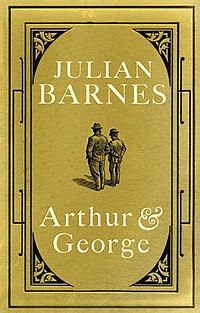
Book Look: Arthur & George, Julian Barnes


I enjoyed this book on a variety of levels: as a historic recreation of an obscure but interesting historical incident; as a biography of Sir Arthur Conan Doyle, the legendary author/creator of Sherlock Holmes; but also a thoughtful exploration of an enduring literary mystery: how Doyle, a man so dedicated to logic and scientific reasoning, could, in later years, have become infatuated with so infamous a pseudo-science as spiritualism.

As a historic novel/recreation, this is a worthy and highly readable effort. Barnes evokes, with seeming effortlessness, a sure and convincing sense of period: not just the "props" - the clothes , the manners - but the ways in which Victorians viewed the world, their role in the world, and themselves. Barnes is especially strong when recounting the role that circumstance, prejudice, ignorance and pride play in ensnaring Eydalji. These chapters - full of mounting suspense and menace - are among the best in the book and made me miss more than one meal. Moreover, Barnes uses the vehicle of the murder mystery as a chance to explore larger themes such as prejudice (conscious and unconscious), human resiliency, and the evolution of the English justice system.

The story also works as an incomplete but intriguing bio of Sir Arthur Conan Doyle, exploring the role that his absentee artist father, his Scottish mother, and his "traditional" British upbringing shaped him into the man that he became, a simultaneous embodiment of the past (ex: his chivalric but rather clueless attitude towards women), the present (ex: he was an avid sportsman, numbered among his acquaintances most of the notable men of the period, and even dabbled in politics), and the future (ex: his Sherlock Holmes stories famously foreshadowed the use of forensic evidence to solve crimes). But make no mistake: this is no homage. Barnes' Doyle may be clever, accomplished, and driven by a sense of honor, but he is also crippled by intellectual vanity.

However, I believe Barnes' primary goal (and greatest achievement) is his exploration of how a man as rational as Doyle - not just the creator of Sherlock Holmes, but a trained medical doctor - can have developed so deep and (seemingly) irrational a fascination with spiritualism. How could the man who gave birth to Sherlock Holmes believe in ectoplasm, telepathy, mesmerism, ouija boards, spirit writing, and (perhaps most famously) fairies? Barnes' depicts Doyle as a man so tormented by rational doubts about organized religion, he finds himself seduced by spiritualism and its promise of providing scientifically verifiable evidence of an afterlife. Alas, however, Doyle's intellectual vanity prevents him not only from identifying the real culprit behind the crimes of which Eydalji is accused, but also prevents him from being able to rationally debunk the spiritualists who successfully manipulate him into believing what he wishes to believe.

Which eventually leads the reader back to the major theme of this story: that people will find a way to believe what they want to believe, no matter how irrational the conclusion. The way a normally "just" justice system came to believe Eydalji guilty of murder. The way Doyle convinces himself that he can love two women without compromising his honor. The way humans continue to believe that the spirits of their beloved dead still walk among us, just waiting for us to find a way to communicate with them.

8/05/2011

Great Literary Feuds


Was recently discussing with a friend the famous Hemingway/Faulkner feud. What elevates literary feuds over your ordinary Hatfield vs. McCoy type disputes, we agreed, is the quality of the epigrams.  Really, does it get much better than: "Concerning no subject would he be deterred by the minor accident of complete ignorance from penning a definitive opinion" - Roger Scruton's homage to George Bernard Shaw?

The upshot of this conversation was a decision to research other famous literary feuds. Turns out there's not really any one good source, so decided to pull together my researches into this one blog post.  I've cited my sources as appropriate, though sometimes I've taken the liberty of adding a snide aside.  I believe Hemingway et. al. would approve.

My research revealed that - not entirely a surprise - Ernest Hemingway was a repeat offender: he also feuded with Wallace Stevens and Gertrude Stein.  Nor is Hemingway the only serial feuder: turns out luminaries including Naipaul, Vidal, Rushdie and Mark Twain have also been involved in multiple disputes. 
  1. Ernest Hemingway vs. William Faulkner. The feud is famous mostly for the epigrams it generated: First, William Faulkner, speaking of Ernest Hemingway: "He has never been known to use a word that might send a reader to the dictionary." And Hemingway’s response: "Poor Faulkner. Does he really think big emotions come from big words?" Personally, I think they both make valid points.
  2. Ernest Hemingway vs. Gertrude Stein.  As Hemingway remembered, he and Gertrude Stein were once “just like brothers.” But a froideur grew between the two when Hemingway was disparaging about Sherwood Anderson, whom Stein felt was one of Hemingway’s greatest influences. Later, Stein published an unflattering portrait of Hemingway in The Autobiography of Alice B. Toklas. Hemingway finally took his revenge in A Moveable Feast, in which he criticized Stein’s prose for its use of “repetitions that a more conscientious and less lazy writer would have put in the waste basket.” [SOURCE: http://www.thedailybeast.com/galleries/2010/05/21/literary-feuds.html]
  3. Ernest Hemingway vs. Wallace Stevens.  After Hemingway heard that Stevens was supposedly trash-talking about him, they got in a scuffle on the streets in Florida. Stevens broke his hand when he punched Hemingway in the jaw. Gotta love Papa for taking it to the street!  [SOURCE: http://www.huffingtonpost.com/2011/02/09/famous-literary-fights_n_820022.html#s236399&title=CS_Lewis_vs]
  4. Norman Mailer vs. Gore Vidal.  If Mailer—the violently sexist homophobe—and “exquisite” Vidal have anything in common, it is their love of a good feud. Mailer—whose past opponents include his second wife, whom he stabbed, Tom Wolfe, critic Michiko Kakutani, Truman Capote, and Germaine Greer—was enraged when Gore Vidal compared Mailer’s The Prisoner of Sex to “three days of menstrual flow” and Mailer to Charles Manson. In response, Mailer head-butted him in the green room of the Dick Cavett Show in 1971, and then told him on-air, that he “ruined” Kerouac by sleeping with him. Six years later at a Lally Weymouth soirée, he threw a drink at Vidal, and punched him. Even lying on the floor, Vidal somehow won the match: “As usual, words fail him,” he sniffed. [SOURCE: http://www.thedailybeast.com/galleries/2010/05/21/literary-feuds.html]
  5. Truman Capote vs. Gore Vidal.  Capote and Vidal began their lifelong feud in the 1940s. Vidal bitterly resented Capote's usurping of a role he thought rightfully his - the promising young American novelist. "How can you call anyone talented who's only written one book at 23?" Vidal asked. "I've written three books, and I'm only 22!" The pair traded insults for years. Vidal called Capote ''a dumpy little lowbrow" forever peddling "a public relations campaign masquerading as a career". Capote said: "Of course, I'm always sad about Gore. Very sad that he has to breathe every day." Capote's attempt at a reconciliation in 1969 did not stop the insults; when he died, Vidal responded: "Good career move." In his memoirs, Vidal calls Capote "a pathological liar." [SOURCE: http://www.independent.co.uk/arts-entertainment/books/features/best-of-enemies-the-truth-behind-a-30year-literary-feud-440035.html]
  6. Mario Vargas Llosa and Gabriel García Márquez.  In what the Times of London has called "possibly the most famous literary feud of modern times," these two Latin American novelists, who were at one time close, spent more than 30 years not speaking before Vargas Llosa wrote a prologue for the 40th anniversary edition of García Márquez's novel One Hundred Years of Solitude. The reason for the feud? Reportedly, it had to do with advice García Márquez gave Vargas Llosa's wife -- to divorce her husband after he had taken up with another woman. [SOURCE: http://www.latimes.com/entertainment/news/arts/la-ca-hemingway-sidebar26-2009jul26,0,7106709.story]
  7. Herman Melville and Nathaniel Hawthorne.  Melville and Hawthorne were friends for only a couple of years, from 1850, when they met, until 1852, when they stopped corresponding. As to why this was, one possible reason is Hawthorne's inability to get Melville a job with the U.S. government, which, notes the website The Life and Works of Herman Melville, left the Moby-Dick author "embarrassed and chagrined."  [SOURCE: http://www.latimes.com/entertainment/news/arts/la-ca-hemingway-sidebar26-2009jul26,0,7106709.story]
  8. Leo Tolstoy, Fyodor Dostoevsky and Ivan Turgenev.  There was no love lost among these three 19th century Russian giants, despite the fact that they had much in common, aesthetically and politically. According to a 2008 piece in Salon magazine, they spent many years sniping (Dostoevsky satirized Turgenev in his novel The Possessed) -- an enmity that came to a head in 1861 when Tolstoy challenged Turgenev to a duel. [SOURCE: http://www.latimes.com/entertainment/news/arts/la-ca-hemingway-sidebar26-2009jul26,0,7106709.story]
  9. Arthur Rimbaud and Paul Verlaine. The French poets met in 1871 and became lovers; within a year or so, the relationship grew fraught. In 1873, they reunited in Brussels, but it took only two days before Verlaine bought a gun and got drunk and shot Rimbaud in the wrist. Verlaine was charged with attempted murder and sentenced to a two-year prison term. [SOURCE: http://www.latimes.com/entertainment/news/arts/la-ca-hemingway-sidebar26-2009jul26,0,7106709.story]
  10. Jack Kerouac and Allen Ginsberg.  Even in the early days of their relationship, there was an undertone of suspicion on Kerouac's part; in a 1952 letter, he wrote that Ginsberg should "leave me alone . . . & dont ever darken me again." But in the 1960s, after Kerouac rejected the counterculture that he and Ginsberg had helped create, things turned truly virulent, with the On the Road writer veering into anti-Semitism to denigrate his onetime friend. [SOURCE: http://www.latimes.com/entertainment/news/arts/la-ca-hemingway-sidebar26-2009jul26,0,7106709.story]
  11. Mark Twain vs. Bret Harte. In his autobiography, written four years after Harte's death, Mark Twain characterized Harte and his writing as insincere. He criticized Harte's writing style, accused Harte of borrowing money from his friends with no intent to repay, and claimed the author financially abandoned his wife and children. If you ask me, though, it doesn't really count as a feud if one of the guys is dead and so (presumably) can't defend himself. [SOURCE: http://en.wikipedia.org/wiki/Bret_Harte]
  12. Mark Twain vs. James Fenimore Cooper.  Another more or less one-sided feud, in which Twain skewers Cooper over perceived deficits in the authors' The Deerslayer and the Pathfinder, which he outlines in an essay entitled: "Fenimore Cooper's Literary Offenses".  Here's an example: "In one place in Deerslayer, and in the restricted space of two-thirds of a page, Cooper has scored 114 offences against literary art out of a possible 115.  It breaks a record." Can't find any record that Cooper retaliated: perhaps he just let the sales of his books - which were HUGE - do the talking for him!     
  13. Salman Rushdie vs. John Updike.  In 2006, John Updike panned Rushdie’s novel, Shalimar the Clown, in The New Yorker, asking “Why, oh why did Salman Rushdie, in his new novel call one of his major characters Maximilian Ophuls?'' Rushdie later responded in The Guardian, “Why oh why ...? Well, why not? Somewhere in Las Vegas there's probably a male prostitute called ‘John Updike’”. He added that Updike's latest novel, Terrorist, was “beyond awful,” and that Updike should “stay in his parochial neighborhood and write about wife-swapping, because it's what he can do.” [SOURCE: http://www.thedailybeast.com/galleries/2010/05/21/literary-feuds.html]
  14. Salman Rushdie vs. John Le Carre.  Salman Rushdie has loathed John Le Carré for years, believing that the writer had sided with his enemies following the publication of The Satanic Verses. Le Carré responded, saying: "I never joined his assailants. Nor did I [proclaim] him to be... innocent. My position was that there is no law in life... that says great religions may be insulted with impunity." Rushdie said that anyone who questioned him was an "ignorant, pompous, semi-literate unperson", and had the final word in an exchange of letters in The Guardian. "It's true I did call him a pompous ass, which I thought pretty mild in the circumstances," he said. "'Ignorant' and 'semi-literate' are dunces' caps he has skilfully fitted on his own head. I wouldn't dream of removing them." [SOURCE: http://www.independent.co.uk/arts-entertainment/books/features/best-of-enemies-the-truth-behind-a-30year-literary-feud-440035.html]
  15. V.S. Naipaul vs. Paul Theroux.  The two writers were friends for decades, with Naipaul acting as a mentor to the younger Theroux. But they fell out in 1996 when Theroux discovered through a bookseller’s catalogue that one of his own books, which he had fondly inscribed to Naipaul and his first wife, was being offered for sale for $1,500. Naipaul told Theroux to “take it on the chin and move on”; Theroux didn’t, and went on to write a book, Sir Vidia’s Shadow, in which he described Naipul’s “elevated crankishness.” Later, Theroux denounced Naipaul’s criticisms of E.M. Forster and Keynes as “the sort of explosive abuse you get from someone whose Valium has worn off.”  However, this fued may be destined for a happier ending than most: at the Hays Festival in 2011 the two authors are reported to have talked and shaken hands. [SOURCE: http://www.thedailybeast.com/galleries/2010/05/21/literary-feuds.html; http://www.telegraph.co.uk/culture/hay-festival/8545401/Hay-Festival-2011-Handshake-ends-a-famous-literary-feud.html]
  16. V.S. Naipaul vs. Derek Walcott.  In his book, A Writer’s People, Naipaul wrote that Walcott “went stale,” and “exhausted the first flush of his talent.” Walcott then wrote “The Mongoose,” a poem about Naipaul, which begins: “I have been bitten, I must avoid infection/Or else I’ll be as dead as Naipaul’s fiction.” A later part asserts: “The plots are forced, the prose sedate and silly/The anti-hero is a prick named Willie.” [SOURCE: http://flavorwire.com/183467/10-notorious-literary-spats/4]
  17. Tom Wolfe vs. Norman Mailer, John Irving, and John Updike.  In 1998, three writers—Mailer, Updike, and Irving—lashed out against Tom Wolfe’s 1998 novel, A Man in Full. "It's like reading a bad newspaper or a bad piece in a magazine. It makes you wince," Irving said. Norman Mailer, writing in The New York Review of Books, compared reading the Wolfe novel to making love to a 300-pound woman: “Once she gets on top it's all over. Fall in love or be asphyxiated.” In his New Yorker review, John Updike wrote that the book “still amounts to entertainment, not literature, even literature in a modest aspirant form.” Wolfe lashed out at each in turn, and collectively called his opponents “the Three Stooges.” [SOURCE: http://www.thedailybeast.com/galleries/2010/05/21/literary-feuds.html]
  18. Mary McCarthy vs. Lillian Hellman.  The antagonism between author and critic Mary McCarthy and playwright Lillian Hellman is that rare thing—a literary duel between two female writers. In January 1980, as a guest on the Dick Cavett show on PBS, McCarthy called Hellman “a dishonest writer” and claimed that “every word she writes is a lie, including ‘and’ and ‘the.’” Hellman—a playwright known for melodrama—responded by filing a $2.25 million lawsuit against McCarthy, Cavett, and PBS. The dispute inspired Norman Mailer—an unlikely advocate of peace—to urge Hellman to drop the case. If she won, he warned, “then every American writer will have to feel that much more tongue-tied at daring to criticize another American writer without qualification.” [SOURCE: http://www.thedailybeast.com/galleries/2010/05/21/literary-feuds.html]
  19. Henry James vs. H.G. Wells.  James, revered as the most sensitive of novelists, grew increasingly incensed by the prolific output of H.G. Wells, the ground-breaking writer of science fiction, whom he accused of valuing substance over style. In 1915, Wells published a parody of the master’s long-winded prose and exalted view of literature. A James novel was, he wrote, “like a church lit, but without a congregation to distract you, and with every light and line focused on a high altar, and on the altar, very reverently placed, intensely there, is a dead kitten, an eggshell, a bit of string…” [SOURCE: http://www.thedailybeast.com/galleries/2010/05/21/literary-feuds.html]
  20. Charles Dickens vs. William Thackeray.  With the 1848 publication of Vanity Fair, Thackeray—previously seen as either a hack or a sentimentalist—was suddenly competition for Dickens, perceived by most as the greatest English novelist. Tension built between the two authors so that when Edmund Yates, a gossip columnist on the staff of Town Talk, attacked Thackeray in his column, Thackeray assumed the assailant was Dickens. The literary quarters of the Garrick Club soon became a war-field and—lest the controversy should blow over—Yates reprinted the correspondence between himself, Thackeray, and Dickens in his magazine for all to read. [SOURCE: http://www.thedailybeast.com/galleries/2010/05/21/literary-feuds.html]
  21. Sinclair Lewis vs. Theodore Dreiser. Theodore Dreiser slapped a drunken Sinclair Lewis after Lewis called him a “son of a bitch who stole three thousand words from my wife’s book” at a literary dinner. That slap, fueled not only by alcohol, but Lewis’ suspicion that Dreiser had also slept with his wife, made national headlines. [SOURCE: http://electricliterature.com/blog/tag/literary-feud/]
  22. Edmund Wilson vs. Vladimir Nabokov. Nabokov, author of Lolita, and the critic Edmund Wilson fell out after a quarter-century of close friendship. The dispute hinged on the translation of a phrase in Pushkin's Eugene Onegin. The pair met in 1940 in the United States, after Nabokov fled from Paris. Wilson introduced his work to American editors. In their letters they called each other Bunny and Volodya. But when the critic panned Nabokov's Onegin translation, the friendship cooled amidst a public feud. Wilson had also disliked Lolita, a fact that Wilson's biographer Lewis Dabney felt was the real origin of their feud. Nevertheless, Nabokov never badmouthed his old friend, in spite of the dispute. [SOURCE: http://www.independent.co.uk/arts-entertainment/books/features/best-of-enemies-the-truth-behind-a-30year-literary-feud-440035.html]
  23. C.P. Snow vs. F.R. Leavis. In the 1850s poet C.P. Snow gave a very provocative and well regarded speech known commonly now as the Two Cultures lecture.  Never mind what it was about: what you want to know is that, some three years later, famous British literary critic and English educator F.R. Leavis decided to take a blast at Snow’s speech in another noted Cambridge peroration, the Richmond Lecture. In the process, Leavis generated the mid-century equivalent of a spat between Keith Olbermann and Bill O’Reilly. The sheer brutality of Leavis’s assault got everybody talking: It spent far more time denigrating Snow personally than it did dismantling his argument. And ironically, it probably only increased Snow’s fame and notoriety, which by this time placed him among Britain’s and the world’s top tier of public intellectuals. [SOURCE: http://www.scienceprogress.org/2009/04/the-science-lover-and-the-snob/]
  24. Albert Camus vs. Jean-Paul Sartre.  Existential death match! The two had a major falling-out over existential philosophy. [SOURCE: http://www.huffingtonpost.com/2011/02/09/famous-literary-fights_n_820022.html#s236399&title=CS_Lewis_vs]
  25. Stephen King vs. James Patterson.  After accepting a lifetime achievement award from the Canadian Booksellers Association, King said of James Patterson, “I don’t like him, I don’t respect his books because every one is the same.” Patterson later replied, “Recently Stephen King commented that he doesn’t have any respect for me. Doesn’t make too much sense — I’m a good dad, a nice husband — my only crime is I’ve sold millions of books.” [SOURCE: http://therumpus.net/2011/06/brush-up-on-your-literary-feuds/]
  26. Bevis Hillier vs. A.N. Wilson.  The feud between rival Betjeman biographers started when Wilson reviewed the second volume of Hillier's three-volume official biography. He called it "a hopeless mish-mash", adding that Hillier wasn't really a writer. One of Hillier's rules in life is: "Who kicks me, gets kicked back." And kick he did, choosing two of Wilson's books as his non-books of the year in The Spectator. One was The Victorians - from which, Hillier pointed out, Wilson had omitted Brunel. The other was Wilson's novel My Name is Legion, which Hillier described as "flabbily plotted". Enraged, Wilson devoted two Daily Telegraph columns to Hillier, one describing him as "old, malignant and pathetic". Wilson then reviewed the third volume of Hillier's Betjeman biography, calling it "naive" and "clumsy". And so on, building to the moment last year when a letter turned up in the Wilson biography purporting to have been written by a mistress of Betjeman's. It was a hoax letter sent to Wilson by Hillier, and the clue lay in the first letter of each sentence. They spelt the message: "AN Wilson is a shit". [SOURCE: http://www.independent.co.uk/arts-entertainment/books/features/best-of-enemies-the-truth-behind-a-30year-literary-feud-440035.html]

If you enjoyed these, check out The 50 Best Author vs. Author Putdowns of All Time.  Not all of these erupted into feuds, but most of them should have!

7/31/2011

Sequels to Cowboys & Aliens


Not since Snakes on a Plane have I enjoyed a movie title as much as Cowboys & Aliens.  Waxing (semi) serious for a moment, though, isn't it as likely that aliens would visit the West during the 1800s as it is likely they would visit Devil's Mountain in the 1970s, the plot of plausible sort of movie called Close Encounters of the Third Kind?  Which got me thinking about all kinds of ideas for sequels, should Cowboys and Aliens prove to be a hit.  Here are some of my favorites:
  1. Aliens vs. the 300.  Sure, the aliens win in the end, but not before we get to see a lot of alien corpses pile up in the pass of Thermopylae. 
  2. Aliens vs. the Gods of Olympus.  Ray guns vs. thunderbolts ... I'd like to see that match-up!
  3. Aliens vs. Ninjas.  Speaking of matchups, I'm gonna have to take the ninjas in this one.  What use are high tech weapons against warriors who can move invisibly, shield their body temperature from sensors, and dodge energy pulses?
  4. Aliens vs. the Roman Legion.  I'm not sure who would win, but love the idea of the Roman Senate desperately sending forth champions to halt the alien onslaught.  Boy are they going to wish they hadn't turned Russell Crowe into a gladiator.
  5. Aliens vs. the Barbarians.  Doesn't matter which barbarians, but am voting for whatever tribe Arnold Schwartzenagger's Conan came from, in hopes all the men are as well developed.
  6. Aliens vs. The Knights of the Round Table.  Think about it - this could be a great fit.   Excalibur turns out to be the only weapon that can kill them, and the Holy Grail turns out to be a signaling device that has to be found and destroyed so the aliens can never find us again.  The script practically writes itself!
  7. Aliens vs. Nazis.  This is a win-win, because no matter who loses in the end, it's okay with us.
  8. Aliens vs. Vampires (or zombies).  Since almost every movie being filmed these days has something to do with vampires or zombies, figure this is a natural.* 
  9. Aliens vs. Planet of the Apes.  They've figured out how to outsmart humans, but are the big monkeys ready to outsmart aliens? 
  10. Aliens vs. Rednecks. My favorite potential sequel of all, and I'm definitely taking the rednecks.  Can't imagine much more fun than 2hrs of watching aliens get run over by trucks, plowed down by trains, and picked off from behind duck blinds.  And for the finale, the rednecks can lure the aliens to a trailer park just as a tornado is coming ...! ("They never saw it coming, Bubba!" "How could they? We never do!")
(*My son says that Plan 9 From Outer Space has already taken this on, but my recollection is that vampires/zombies are allied with the aliens rather than pitted against them.  Totally different.)

7/29/2011

Tonight I'm Gonna Cry Playlist: Songs That Make Me Cry

What is it about some songs that make us bawl like a baby?
  • Is it regret? (Cats in the Cradle, Wasted Time, The Living Years, Yesterday)  
  • Death? (Amazing Grace, Tears in Heaven)  
  • Doomed Love? (Somewhere) 
  • Lost Love? (Against the Odds, Weekends in New England) 
  • Lost youth? (It Was a Very Good Year, 100 Years, I Loved These Days) 
  • The glory/horror of war? (Brothers in Arms, Some Gave All, Goodnight Saigon, Taps) 
  • Patriotism? (The Battle Hymn of the Republic, America) 
  • Songs that fill you with hope that, no matter how bad things get, there's something better Over the Rainbow? (What a Wonderful World, Imagine, Rainbow Connection). 
  • Sometimes, the words don't even matter - all it takes is a heart-breaking chord change or crescendo to tear at our hearts, like Samuel Barber's haunting Adajio for Strings or Jeff Buckley's wrenching versoin of Hallelujah.  
Then again, does it matter? The point is that whenever I feel the need for a good, purging cry, these songs are guaranteed to deliver the tears.
  1. 100 Years, Five for Fighting
  2. Adagio for Strings, Samuel Barber
  3. Afterglow, Genesis
  4. Against All Odds, Phil Collins
  5. All By Myself, Eric Carmen
  6. All I Ask of You, Phantom of the Opera
  7. Allegretto, Symphony No. 7, Beethoven
  8. Amazing Grace, any version
  9. America, Ray Charles
  10. American Pie, Don McLean
  11. Angel, Sarah McLachlan
  12. Are You Lonesome Tonight, Elvis Presley
  13. At 17, Carly Simon
  14. Ave Maria, any version
  15. Auld Lang Syne, any version
  16. Battle Hymn of the Republic, any version
  17. Big John, Tennessee Ernie Ford
  18. Bird on the Wire, Leonard Cohen
  19. Blue in Green, Miles Davis
  20. Both Sides Now, Joni Mitchell
  21. The Boxer, Simon and Garfunkle
  22. Brandy, Looking Glass
  23. Bridge Over Troubled Water, Simon & Garfunkel
  24. Bring Him Home, from Les Miserables
  25. Brothers in Arms, Dire Straits
  26. Candle in the Wind, Elton John
  27. Canon in D, Pacelbel
  28. Cat's in the Cradle, Harry Chapin
  29. Crazy Love, Van Morrison
  30. Crying, Roy Orbison
  31. The Crying Game, Boy George
  32. The Dance, Garth Brooks
  33. Dang Me, Roger Miller
  34. Danny Boy, any version
  35. Dante's Prayer, Loreena McKennitt
  36. Days, Elvis Costello
  37. The Death of Falstaff, from Henry V
  38. Desperado, Eagles
  39. Don't Cry for Me Argentina, from Evita
  40. Don't Take the Girl, Tim McGraw
  41. Dream, Bob Dylan
  42. Dust in the Wind, Kansas
  43. Eleanor Rigby, Beatles
  44. Empty Chairs and Empty Tables, from Les Miserables
  45. Empty Garden, Elton John
  46. Evergreen, Barbra Streisand
  47. Everybody Hurts, REM
  48. Fanfare for the Common Man, Aaron Copeland
  49. Fields of Gold, Eva Cassidy
  50. Fire and Rain, James Taylor
  51. The First Time Ever I Saw Your Face, Roberta Flack
  52. Fix You, Cold Play
  53. Forget Her, Jeff Buckley
  54. The Gambler, Kenny Rogers
  55. Georgia on my Mind, Ray Charles
  56. The Ghost of Tom Joad, Bruce Springsteen
  57. Good Riddance, Green Day
  58. Goodnight Saigon, Billy Joel
  59. Greatest Love of All, Whitney Houston
  60. Growin' Up, Bruce Springsteen
  61. Hallelujah, Jeff Buckley (or Pentatonix)
  62. Hello, Adele
  63. Hurt, Johnny Cash
  64. Hushabye Mountain, from Chitty Chitty Bang Bang
  65. I Can't Make You Love Me, Bonnie Raitt
  66. I Don't Want to Miss a Thing, Aerosmith
  67. I Grieve, Peter Gabriel
  68. I Have Nothing, Whitney Houston
  69. I Dreamed a Dream, from Les Miserables
  70. I Was a Fool to Let You Go, Barry Manilow
  71. I Won't Let Go, Rascal Flatts
  72. If, Bread
  73. If I Die Young, The Band Perry
  74. If You're Reading This, Tim McGraw
  75. I'll Stand By You, Glee
  76. I'm A Fool To Want You, Carly Simon
  77. I'm Moving On, Rascal Flatts
  78. Imagine, John LennonIn Your Eyes, Peter Gabriel
  79. The Impossible Dream, Man of LaMancha
  80. In a New York Minute, Don Henley
  81. In a Sentimental Mood, Duke Ellington
  82. In the Ghetto, Elvis Presley
  83. In the Wee Small Hours, Carly Simon
  84. Iris, Goo Goo Dolls
  85. It Was Very Good Year, Frank Sinatra
  86. It's Not Easy Being Green, Ray Charles
  87. It's Too Late, Carole King
  88. I've Loved These Days, Billy Joel
  89. Keep Holding On, Avril Lavigne
  90. Landslide, Fleetwood Mac
  91. Last Goodbye, Jeff Buckley
  92. The Last Song, Elton John
  93. The Leader of the Band, Dan Fogleberg
  94. Let Her Go, Passenger
  95. Let It Be, Beatles
  96. Lilac Wine, Jeff Buckley
  97. The Living Years, Mike and the Mechanics
  98. The Long and Winding Road, Beatles
  99. A Long December, Counting Crows
  100. Lover, You Should Have Come Over, Jeff Buckley
  101. The Luckiest, Ben Folds
  102. Mad World, Michael Andrews
  103. Make You Feel My Love, Adele
  104. Memories, Barbra Streisand
  105. A Million Fireflies, Midway State
  106. Moon River, Louis Armstrong
  107. Mother's Pride, George Michael
  108. More than Words, Extreme
  109. Mr. Bojangles, Nitty Gritty Dirt Band
  110. Music of the Night, from Phantom of the Opera
  111. My Eyes Adored You, Frankie Valli
  112. My Funny Valentine, Sarah Vaughn
  113. My Immortal, Evanescence
  114. My Way, Frank Sinatra
  115. Nessun Dorma, Turnadot
  116. Nightswimming, REM
  117. On My Own, from Les Miserables
  118. One Day More, from Les Miserables
  119. One Hand/One Heart, from West Side Story
  120. One Moment in Time, Whitney Houston
  121. Operator, Jim Croce
  122. Philadelphia, Bruce Springstein
  123. Promentary, from Last of the Mohicans
  124. Proud to be An American, Lee Greenwood
  125. Puff the Magic Dragon, Peter, Paul and Mary
  126. Rainbow Connection, Kermit the Frog
  127. Rainy Days and Mondays, The Carpenters
  128. Redemption Song, Joe Strummer and Johnny Cash
  129. Romeo & Juliet, Dire Straits
  130. Say Something, Great Big World & Christina Aguilera
  131. Seasons in the Sun, Terry Jacks
  132. See You Again, Charlie Puth w/Wiz Khalifa
  133. Send in the Clowns, Judy Collins
  134. Set Fire to the Rain, Adele
  135. Smoke Gets in Your Eyes, Nat King Cole
  136. Solsbury Hill, Peter Gabriel
  137. Some Gave All, Billy Ray Cyrus
  138. Someone Like You, Adele
  139. Someone You Loved, Lewis Capaldi
  140. Sometimes When We Touch, Dan Hill
  141. Somewhere (A Place for Us), from West Side Story
  142. Somewhere Out There, Linda Rondstadt
  143. Somewhere Over the Rainbow, Israel Kamakawiwo'ole
  144. Sorry Seems to be the Hardest Word, Elton John
  145. Sound of Silence, Simon & Garfunkle (or Pentatonix)
  146. Stand By Me, BB King
  147. Stardust, Glen Miller
  148. Strange Fruit, Billie Holliday
  149. Streets of Philadelphia, Bruce Springsteen
  150. Summertime, Louis Armstrong
  151. Sunrise/Sunset, from Fiddler on the Roof
  152. Superman, Five for Fighting
  153. Taps, any version
  154. Tears in Heaven, Eric Clapton
  155. There's a Place For Us, from West Side Story
  156. These Three Words, Stevie Wonder
  157. This Woman's Work, Maxwell (or Kate Bush)
  158. Time After Time, Cyndi Lauper
  159. Time in a Bottle, Jim Croce
  160. Time to Say Goodbye, Sarah Brightman and Andrea Bocelli
  161. Times of Your Life, Paul Anka
  162. To Sir With Love, Lulu
  163. Tonight I'm Gonna Cry, Keith Urban
  164. True Colors, Cindi Lauper
  165. Unchained Melody, Righteous Brothers
  166. You Were Always on My Mind, Willie Nelson
  167. Walking in Memphis, Marc Cohn
  168. Wasted Time, Eagles
  169. Weekends in New England, Barry Manilow
  170. Weight of Lies, Avett Brothers
  171. We're Just Friends, Wilco
  172. What a Wonderful World, Louis Armstrong
  173. What I Did For Love, Barbra Streisand
  174. When I See You Again, Wiz Khalifa
  175. When I Was Your Man, Bruno Mars
  176. When Somebody Loved Me, Sara McLachlan
  177. When the Party's Over, Billie Eilish
  178. Who Wants to Live Forever, Queen
  179. Wildfire, Michael Martin
  180. The Wind, Cat Stevens
  181. Wishing You Were Here, Chicago
  182. Wreck of the Edmund Fitzgerald, Gorden Lightfoot
  183. Yesterday, Beatles
  184. You Are So Beautiful, Joe Crocker
  185. You Don't Know Me, Ray Charles
  186. You Raise Me Up, Josh Groban

7/20/2011

"Guilty Pleasure" Movies


It's easy to pick awful movies; much more difficult to fess up to those "guilty pleasure" movies.  You know - the ones you hide under your coat at the video store so that no one sees you check them out.  The ones you quickly click away from when someone walks into the room.  The ones you lie about when friends call: "Oh, I'm just watching a movie.  Yeah - um -
Private Ryan."   The ones that you love, but that you're not willing to publicly admit you love.

Here are some of my guilty pleasures; feel free to snigger.
  1. The 10 Commandments.  It's epic-ly cheesy, but there's something about the combination of over-the-top costuming, shameless overacting, and goofy special effects that keeps me coming back every Easter for more. 
  2. St. Elmo's Fire.  Actually, pretty much any of those movies staring the "brat pack":  16 Candles, Pretty in Pink ....  They were all so painfully '80s and yet I can't help watching them everytime they come on television.  Maybe it's the music? the fashion? the 80s angst? the really big hair?
  3. Planet of the Apes.  I don't even listen to the dialog anymore - I just enjoy the monkey makeup and the many fabulous quotes, to include a favorite of mine: "Take your stinking paws off me, you damned dirty ape!"
  4. Army of Darkness.  Not sure I'm allowed to include this on the list, since - unlike the other movies on this list - it was made with the intention of being bad.  But something funny happened along the way: they made a movie so goofily hilarious that it's practically irresistable.
  5. Starship Troopers.  Recently named one of the worst movies ever made, yet there's something captivating about the timeless "man vs. bugs from outer space" theme that keeps sucking me in.
  6. 9 to 5.  It's everything that's wrong/right about movies made during the 70s* - socially preachy conflict (sexual harassment) + questionable 70s icons in starring roles (Jane Fonda, Lily Tomlin, Dolly Parton) + the same incredibly juvenile slapstick sense of humor that brought us movies like Every Which Way But Loose, pairing Clint Eastwood with a monkey. And yet, I never tire of watching the gals avenge themselves on their sexist rat of a boss, played by ubiquitous '70s baddie Dabney Coleman.  (*Okay, technically the movie was released in 1980, but that means it was written/filmed in the '70s.)
  7. Three Muskateers + cheesy pirate/swordfighting movies.  The acting is extraneous, the time period is inconsequential, the plot is immaterial; they have me at "swordfight."  Honorable mentions in this category include Highlander, Conan the Barbarian, and the truly terrible Cutthroat Island. 
  8. Dirty Dancing + all cheesy dance/cheerleading/band/music movies.  You know, those movies where the plucky young lead has to conquer obstacles in order to achieve thier dream of becoming a successful dancer/singer/musician/cheerleader.  (And, along the way, win the heart of their "other side of the tracks" love interest.)  Think Fame, Flashdance, Center Stage, Drum Line, etc.  People knock this genre for being so predictable, but that's what I love about it: a little music, a bit of a love interest, and a happy ending.  All that's missing is a bit with a dog.
  9. Muppet movies. I never specified that "guilty pleasures" have to be bad movies, just embarassing!  One way or another I've managed to furtively enjoy many of these - The Mupppet Movie, The Great Muppet Caper, Muppet Treasure Island, A Muppet Christmas Carol - and foudn them to be uniformly entertaining and charming.  I'm just not necessarily ready to share this with others.
  10. Anything starring Goldie Hawn.  You know what I'm talking about.  Overboard.  Wildcats.  Swing Shift.  Private Benjamin.  They're preposterous, they're formulaic, and they're almost always insulting to women. (The ditzy character GH inevitably plays was, I think, meant to be a throwback to The Honeymooners and All In the Family, a period when Hollywood considered ditzy female characters to be entertaining rather than condescending and insulting).   And yet, everytime they pop up on one of the cable channels, I find myself watching ... while simultaneously keeping one finger poised on the "back" button so that, at any time, I can quickly return to The History Channel should someone unexpectedly enter the room. 
So, what are your "guilty pleasures"?

7/16/2011

Insults of the Famous and Literate

Think you're pretty adept with witty insults, taunts and put-downs?  The following collection of insults by the famous and literate is guaranteed to leave you humbled, and wholly amused.
  1. “He has all the virtues I dislike and none of the vices I admire.” -Winston Churchill
  2. “A modest little person, with much to be modest about.” -Winston Churchill
  3. "A sheep in sheep's clothing." - Winston Churchill
  4. "I have never killed a man, but I have read many obituaries with great pleasure.” -Clarence Darrow
  5. “He has never been known to use a word that might send a reader to the dictionary.” -William Faulkner (about Ernest Hemingway)
  6. “Does he really think big emotions come from big words?” -Ernest Hemingway (about William Faulkner)
  7. “Thank you for sending me a copy of your book; I’ll waste no time reading it.” -Moses Hadas
  8. "This is not a novel to be tossed aside lightly. It should be thrown with great force." - Dorothy Parker
  9. “He can compress the most words into the smallest idea of any man I know.” -Abraham Lincoln
  10. “I’ve had a perfectly wonderful evening. But this wasn’t it.” -Groucho Marx
  11. “I didn’t attend the funeral, but I sent a nice letter saying I approved of it.” -Mark Twain
  12. “He has no enemies, but is intensely disliked by his friends.” -Oscar Wilde
  13. "Some cause happiness wherever they go; others whenever they go." -Oscar Wilde
  14. “I am enclosing two tickets to the first night of my new play; bring a friend…. if you have one.” - George Bernard Shaw to Winston Churchill
  15. “Cannot possibly attend first night, will attend second… If there is one.” - Winston Churchill, in response to Bernard Shaw
  16. “He is a self-made man and worships his creator.” - John Bright
  17. “I’ve just learned about his illness. Let’s hope it’s nothing trivial.” - Irvin S. Cobb
  18. “He is not only dull himself, he is the cause of dullness in others.” -Samuel Johnson
  19. “He is simply a shiver looking for a spine to run up.” - Paul Keating
  20. “He had delusions of adequacy.” - Walter Kerr
  21. “There’s nothing wrong with you that reincarnation won’t cure.” -Jack E. Leonard
  22. “He has the attention span of a lightning bolt.” -Robert Redford
  23. “They never open their mouths without subtracting from the sum of human knowledge.” -Thomas Brackett Reed
  24. “He inherited some good instincts from his Quaker forebears, but by diligent hard work, he overcame them.” -James Reston (about Richard Nixon)
  25. “In order to avoid being called a flirt, she always yielded easily.” -Charles, Count Talleyrand
  26. “He loves nature in spite of what it did to him.” -Forrest Tucker
  27. “Why do you sit there looking like an envelope without any address on it?” -Mark Twain
  28. “His mother should have thrown him away and kept the stork.” -Mae West
    “He uses statistics as a drunken man uses lamp-posts for support rather than illumination.” -Andrew Lang (1844-1912)
  29. “He has Van Gogh’s ear for music.” - Billy Wilder
  30. "She looked as if she had been poured into her clothes and had forgotten to say 'when.'" -P.G. Wodehouse
  31. "O, she is the antidote to desire."  -William Congreve
  32. "I could eat alphabet soup and shit better lyrics."  -Johnny Mercer,
  33. "The problem with the gene pool is that there's no lifeguard."  -David Gerrold
  34. “I can’t believe that out of 10,000 sperm, you were the quickest.” - Steven Pearl
  35. "Some people stay longer in an hour than others can in a week." - William Dean Howells
  36. "Pushing 40? She's hanging on for dear life." - Ivy Compton-Burnett
  37. "I feel so miserable without you; it's almost like having you here." - Stephen Bishop
  38. "I have never liked him and I always will." - David Clark
  39. "I regard you with an indifference bordering on aversion." -Robert Louis Stevenson
  40. "He's completely unspoiled by failure." -Noel Coward
  41. "Fine words! I wonder where you stole them." - Jonathan Swift
  42. "You had to stand in line to hate him." - Hedda Hopper
  43. "The trouble with her is that she lacks the power of conversation but not the power of speech." -George Bernard Shaw
  44. "There, but for the grace of God, goes God." - Winston Churchill
  45. "Some folks are wise and some are otherwise." -Tobias George Smolett
  46. "She never lets ideas interrupt the easy flow of her conversation." - Jean Webster
  47. "Ordinarily he is insane.  But he has lucid moments when he is only stupid." - Heinrich Heine
  48. "She has been kissed as often as a police-court Bible, and by much the same class of people." - Robertson Davies
  49. "He was trying to save both his faces." -John Gunther
  50. "Failure has gone to his head." - Wilson Mizner
  51. "God was bored by him." - Victor Hugo
  52. "He had delusions of adequacy." - Walter Kerr
  53. "He has no enemies, but he is intensely disliked by his friends." - Oscar Wilde
  54. "He is as good as his word - and his word is no good." -Seamus MacManus
  55. "He is one of those people who would be enormously improved by death." - H.H. Munro
  56. "He was happily married - but his wife wasn't." - Victor Borge
  57. "She not only kept her lovely figure, she's added so much to it." -Bob Fosse
  58. "He never chooses an opinion; he just wears whatever happens to be in style." - Leo Tolstoy
  59. "He was born stupid, and greatly increased his birthright." - Samuel Butler
  60. "He was distinguished for ignorance; for he had only one idea and that was wrong." - Benjamin Disraeli
  61. "That woman speaks eight different languages and can't say 'no' in any of them." - Dorothy Parker
  62. "He has not so much brain as ear wax." -William Shakespeare
  63. "He's a tried and valiant soldier.  So is my horse." -William Shakespeare
  64. "Her beauty and her brain go not together." - William Shakespeare
  65. "Better a witty fool than a foolish wit." - William Shakespeare
(I gathered these from sources all over the internet so can't vouch for their accuracy; only their entertainment value!)

7/08/2011

A Thousand Words: Cookie Monster


Sometimes change is a good thing. 
Sometimes things are fine just the way they are.

7/05/2011

Book Look: The Monk, Matthew Lewis

Don't be scared off by the book's 18th century publication date: this story is great fun - as shocking and titillating as anything in modern lit. The Monk has it all: scandal, conspiracy, murder, villainy, hypocrisy, incest, rape, betrayal, ghosts, demons, corpses, and enough gruesome detail to rival an episode of CSI.


The story is set in Spain during the time of the Inquisition, and focuses on the corruption and eventual destruction of Ambrosio, "The Man of Holiness", a Capuchin monk whose outward piety conceals vanity and a lust for power, from which seeds grow spiraling tendrils of evil that eventually destroy him, with a little help from Old Smokey himself. (Lucifer actually makes a juicy cameo appearance at the end - don't miss it!).

Love how "meaty" the story is: within the main narrative, Lewis embeds digressions and side stories that add to the entertainment and general spookiness of the story. Caught up in the main narrative (in which the Brave Cavalier Lorenzo attempts to woo the Innocent Virgin Antonia; Noble Raymond attempts to rescue his True Love Agnes from the schemes of Villainous Family Members and an Evil Prioress; and the Mad Monk Ambrosio is gradually corrupted), you may be tempted to skip these parts, but don't! Elvira's sad history, the story of Lorenzo's brush with bloodthirsty bandits in the forests of Germany, and especially the tale of the Bleeding Nun and the Wandering Jew are fully as diverting as the main narrative.

Love, too, how the author incorporates all the stereotypical elements of gothic fiction - mad monks, wicked nuns, brave knights, naïve virgins, scheming family members, crypts, corpses, and sorcery - while still managing to create a story that feels fresh, literate, and well-crafted. Lewis may have picked a dubious genre, but there's nothing dubious about his plotting or prose. Indeed, Ambrosio's decline is presented in so gradual and logical a fashion, will shock you almost as much as it shocks him at the end to realize how far he's fallen, and how fast.

Finally, love how the book lays the foundation for so much literature that's come since. Reading along, you'll catch definite whiffs of Bronte, Poe, Hawthorn, Byron, Eco, and Perez-Reverte, among others. Were I a scholar, would love to research how this text provides a bridge between the old-style horror of medieval morality plays and modern lit.

Because, beneath the shock and titillation, this is at its core a morality play, in which evildoers are punished and virtue is rewarded. (Except for a few necessarily tragic consequences, because evil can't happen without victims, after all). A little spooky, a little melodramatic, a lot entertaining, and good triumphs over evil yet again ... what more do you want from a book?