7/31/2013

50+ Academic Review Games for Learning/Reviewing Any Subject!


Like most teachers, I struggle to make learning and reviewing material as interesting as possible.  Over time, I've scoured the internet as well as the memories of my colleagues to come up with interesting review games.

What I've tried to do here is to consolidate all my researches into a huge, comprehensive list of review games that will work for almost every grade and subject area, so that others following in my footsteps won't have to spend as much time hunting as I have!

To be clear, while some of these games are things I've created or adapted, others are borrowed from other teachers (though only when/if posted in public forums) ... because unlike most other professions, 99% of teachers put the good of the profession ahead of their own intellectual property rights, which I think is pretty awesome.
  1. Traditional games.  The advantage of adapting traditional games to use for review is that you can be pretty sure the kids already know the rules.
    1. Bingo.  Create BINGO cards, filling each square with a different answer (answers can be vocab words, numbers, etc.)  Teacher asks questions; students have to figure out the answer, then check their card to see if the answer is there, then mark it if it is.  First person to get BINGO wins.  TIPS: To save time, put list of answers up on board, give kids empty BINGO cards, and have them randomly assign answers to boxes.  (It's best if you have more answers than you have boxes, as this will further randomize the boards.)  TIP: for each round, track the questions you asked.  Then have the person who shouted BINGO read off their answers so you can check them against your list.  If they have an answer for a question you didn't ask, they have to stand down while the rest of the class continues to play. 
    2. Checkers. Write questions on each box (gold glitter pen works well). Student must correctly answer the question written on the square they want to move to. To "king" themselves, they must also answer a bonus question. MIGHT WORK FOR: math drill, parts of speech drill.
    3. Dominoes.  Great for matching vocab words to their definitions
    4. Hangman.  Ask students a question, then leave blank spaces for every letter in the answer.  Students have to guess the answer before their hangman guy is completed.  To make the game easier/harder, adjust the number of body parts you're going to use (# of guesses you're going to allow) before the guy is considered "hung"
    5. Hopscotch.  Divide students into teams.  Each team works together to answer 10 review questions in writing.  Then each member of team plays hopscotch - BUT, they can't put their foot down on any # they answered incorrectly.  1 point for each member of team who successfully completes a hopscotch round trip; 1 point deducted for each member who fumbles.
    6. Tic-tac-toe.  Write 9 key vocab words (must be related to each other thematically) on 9 index cards.  Kids lay them out in random 3x3 matrix and must create a sentence that uses any three words in a row.  To make this harder, require that they use the words in the order they appear!
  2. Active games.  These games involve throwing, running, catching ... perfect for those days when everyone's feeling drowsy and/or overtested!
    1. Angry Birds.  Ideally, you want an angry bird stuffed animal or ball for this game - but in a pinch you can decorate a tennis ball or beanbag appropriately.  On chalkboard, create grid with different values - 1 point through 10 points, for example.  (I like to fill each square in my 3x3 grid with a different round creature, because the kids find my lack of drawing skills hilarious ... If you're feeling less adventurous, perhaps a dart board design might be easier!)  Each kid throws angry bird stuffie at the grid.  Whatever point value they hit is the points they get for answering the question successfully.  TIP: let the kids stand pretty close to the board, so they are sure to hit something!)
    2. Bluff.  Physically divide class into two groups.  Each team moves to one side of classroom.  Address question to Team A.  Everyone who knows the answer stands.  Someone from Team B calls on any one of the students standing up to answer the question.  If they're correct, Team A gets # of points equal to # of students standing.  BUT, if person on Team A answers wrong, Team B gets all the points!  What makes this fun is the bluffing - each team can rack up their points by having kids who don't know the answer stand, but if their bluff is called by the other team, their team pays the price!
    3. Chaos.  Be warned by the name - this can get loud, fast!  Each team has set of different questions on cards.  At "go" they turn over first card and write the answer on the card (if laminated) or separate piece of paper, then run to front of room where teacher checks it.  If correct, runner gets to roll dice (or some other method of randomly determining points).  Teacher gives team that many points.  Runner returns and they begin working on next question.  Each team answers as many questions as they can in 5 minutes, at the end of which time the teacher counts up all the points and announces a winner.  A little skill + a little luck + a LOT of competitive energy = great review activity!
    4. Flyswatter Game (aka Whack a Word, Slap, Stomp).  Hang vocab words or key concepts on pieces of paper and hang them either on a single wall or chalkboard (to minimize chaos) or around the room (to maximize chaos).  Divide class into two teams.  One person from each team gets flyswatter.  Ask question. First student to "swat" the answer with their flyswatter earns a point for their team.  Then they pass their flyswatters onto next person on their team for another round.
    5. Four Square.  I'm not sure why we call this "four square" at our school, except that it involves using all four corners of the room.  Designate each corner A, B, C, or D.  Call out a multiple choice question.  Students move to the corner that indicates their answer.  If they're right, they get # of points equal to # of students standing in that corner.  But if they're wrong, they subtract # of points equal to # of students standing in that corner.  TIP: there's a tendency for students to go where most of their peers are. To combat this, you may want to give double points if correct answer has less than 50% of class.
    6. Hoops.  Students can choose to answer a question or shoot a basket from the foul line.  If student shoots and scores, team gets 2 points and student doesn't have to answer question.  If student misses, they are given question & if they get it right earn 1 point.  Students who opt for question first get 2 points for right answer; if they get question wrong, they can shoot basketball & try for 1 point.  Not as complicated as it sounds, I promise!
    7. Lineup.  This is a good game for reviewing topics that lend themselves to a particular order.  First, create cards for each member of your set.  At "go", students must line themselves up, from smallest to largest (or whatever order you specify).  First team to successfully sort themselves wins.  I've used this for teaching scientific classification (Kingdom, Phyllum, Class, Order, Family, Genus, Species) and I know of more than one math teacher who's done this with unsolved equations - the kids have to solve the equations & place themselves in order from smallest to largest answer.  I've always wanted to try it with parts of speech: each team has a kid assigned each part of speech, then I throw a sentence up on the board and they have to sort themselves to match the same order as the sentence. (If someone tries this, let me know how it works!)
    8. Pass the Chicken.  A basic quiz game, but instead of giving each student 1 minute to answer the question, they get only as long as it takes for the class, arranged in a circle, to pass the rubber chicken (or whatever other prop you happen to have lying around) all the way around the circle until it returns to the person who is answering.  5 points if they beat the chicken, 3 points if they answer just a little too late, 0 points if they don't answer. 
    9. Quiz-Quiz-Trade. This Kagan activity requires cards, so am including it here. Idea is to create a set of cards with question on one side, answer on other. At "go," students rotate through room pairing with different partners. They quiz each other, then trade cards, then find new partner.
    10. Toss Across1.  This utilizes a "Toss Across" tic-tac-toe beanbag game that's sold in most toy stores.  Attach a question to each block.  Students take turn throwing beanbags BUT only get to keep the square they've successfully turned over by also answering the question: if they don't answer correctly, the square is returned to "neutral".  Fun!
    11. Toss Across2. In this review activity, students take turns reviewing each other. First, they write down three questions and answers that think might stump their classmates. Then line kids up across from each other. First person on one side tosses ball to first person on other side. Student who catches ball has to answer question. If correct, they get a point. If incorrect, person tossing ball gets a point. Person who caught ball then gets to throw it to next person in line on opposite side of room. TIP: you don't necessarily have to form lines - or, having formed lines, you don't have to start with student 1, then student 2, etc. - but you should have some mechanism in place to make sure everyone gets a turn - otherwise, there's a tendency for friends to keep throwing the ball to each other, excluding others.
    12. Trashball. Divide your class into two groups. Ask first student on team A a question.  1 point for correct answer + they have opportunity to add another point if they successfully throw a wadded piece of paper into the trash can from a designated distance.  Then first person on next team gets a turn.  If you want to add another level, make correct answers worth 2 points and offer students option of shooting trashball from close distance (worth 1 point if successful) or further away (worth 2 points if successful).
    13. Twister.  Each color is a word or concept.  The teacher shouts out a question and then rolls for a body part - students have to place the appropriate hand/foot on the appropriate square.  If you choose the wrong answer (or fall down, of course), you're out of the game.  Last man standing - or twisting? - wins! 
    14. Who Am I?  Pin to the back of each student a name, vocab word, or concept.  Students DO NOT know who they are, but must find out by asking yes/no questions.  Since they can ask only 1 question of each student, they have to keep rotating through the room finding new students to quiz.  Winner is the person who guesses who they are first.  This game is a hoot if you don't mind a little chaos!
  3. Board/boxed games.  These games are adapted from board/box games sold in toy stores.  The disadvantage is that they often require preparation/setup, but the advantage is that they've already been proven to be fun and engaging.
    1. Battleship.  Great for reviewing coordinate planes!  Create your own with positive and negative numbers on each axis (x,y) for a more complex challenge
    2. Candyland.  Create an all-purpose review game by using a Candyland board and marking every 5th space or so with a star (or question mark, or whatever).  Students who land on these spots must successfully answer a review question.  If they do, they get to advance to the next space of the same color. If they don't, they have to move backwards to the last space of the same color.
    3. Connect Four.  Great for compare/contrast activities.  Students have to create row of four chips that all relate to the same concept/person/idea.  (For example, the person who links four math problems that use distributive property win.)
    4. Guess Who. The board includes cartoon images of 24 people with all the images standing up. Tape your own pictures on top of these. The game starts with each player selecting a card containing one of the images. The object of the game is to be the first to determine which card one's opponent has selected by asking each other only yes/no questions in order to eliminate candidates. To make the game easier/harder, restrict the types of yes/no questions that can be asked (example: to make it easier, allow kids to ask questions about physical appearance; to make it harder, require that all questions relate to their accomplishments).
    5. Jenga.  In order to withdraw a block of wood from the tower, the player must first successfully answer the question.  You can write the names (or math problems, or whatever) on the blocks of wood, but if you want to reuse the game for various subjects, assign each block a #, then provide list of #d questions for the kids to refer to.
    6. Mad Libs. A perfect way to review parts of speech and grammar!  I have created one that I use the first day of school to help me quickly assess how much they've remembered from the previous year.
    7. Monopoly.  Admit I've never made my own Monopoly-based review game, but I know they sell version that review all sorts of subjects. I love the idea of using the game as a way to help kids build associations - for instance, red properties might be "Jane Addams Ave", "Hull House Heights", and "Progressive Parkway"; while orange properties might be "Rockefeller Road," "Standard Oil Blvd" and "Monopoly Mile". 
    8. Password/Taboo. In Password, one student has to describe a key vocab word until the other student guesses it.  Taboo takes this idea but makes it harder (therefore requiring kids to engage in higher levels of critical thinking) by forbidding the person doing the describing to use a certain set (usually 5) key words. For example, a student might be required to describe the word "Civil Rights" without using: Jim Crow, Martin Luther King Jr., 1960s, discrimination, or segregation. Each team gets 1 minute, during which time they work their way through as many words as possible - 1 point for each one guessed, -1 point for everytime the person giving the clues accidentally uses a forbidden clue. This one requires some advanced planning - you'll have to create the cards and (for Taboo) decide on the 5 words they can't use - but the kids love it.
    9. Pictionary/Charades.  Create slips of paper containing all your important vocab words or key concepts.  One person has to draw them while everyone else guesses what they're drawing.
    10. Scattergories.  Divide students into teams of 3-4.  Call out a letter of the alphabet.  Then call out a category (example: photosynthesis, the U.S. Constitution, exercise equipment).  Studnets have to come up with a word that belongs to the category and starts with that letter.  The catch: they don't get a point unless they are the ONLY group with the word.  This ups the critical thinking level by requiring them to think beyond the most obvious answers.  
    11. Scrabble.  All words have to relate to whatever is being studied.  Justifying why their word is related prompts students to engage in critical thinking.  To make the game easier/shorter/less intimidating, divide all the tiles between 2-3 teams at the outset, so they have plenty of letters to choose from.
    12. Trivial Pursuit. Another obvious review game format: simple create your own categories and questions.
  4. Card games.   Simple review games based on simple card games.
    1. Concentration/Memory. Write vocab words (or key concepts) on a number of index cards, then write their definitions (or answers) on an equal number of index cards. Turn them all upside-down and lay them out in a matrix. Each turn, students may turn over two cards. If they match, they keep the cards. If they don't match, they turn them back over WITHOUT MOVING THEM. Person with the most matches at the end wins. game show games
    2. Go Fish.  Customize a deck of cards so that each set of similar #s (example: all four "8s") are members specific, distinct category.  (Example: 1s are animals, 2s are plants, 3 are fungi, 4 are protists; or, 1s are real numbers, 2s are improper fractions ...).  Then, play as you would play fish, with students asking for cards by category rather than #.
    3. War.  This works as a great drill/review game for math. Create cards where you have to solve equations to figure out the value of the card.  In War, you split the deck in two (or three) and each player turns up their top card at the same time.  The person who has the card with the highest value gets to keep all the overturned cards.   The winner is the person who collects all the cards. Tip: What makes this game fun is that it moves so quickly, so make sure your equations aren't too difficult. (If cards tie, then players turn over another card - winner gets to keep all the cards ... so if you want the game to move more quickly, make sure multiple equations yield the same answer.) 
  5. Game shows.  Review games based on television quiz/game shows.
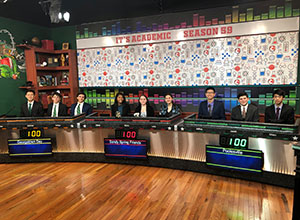
    1. It's Academic. Another obvious choice for review games, except students work together as teams to answer the questions
    2. Family Fued.  Organize your class into two teams.  Place them in a specific order: team captain, 2nd person, 3rd person, 4th person, 5th person, etc.  Ask question.  ONLY 1st person on each team is allowed to give final answer, though they're allowed to confer with their team.  First person to get it right gets 5 points. Repeat with 2nd person on each team, then 3rd people on each team, etc.  Though they can consult with rest of team, they're responsible for answer given.  TIP: This works best when teams are relatively small - no more than 5 people per team.  I'm sure, however, there's some way to adapt it to larger groups if you really want to!
    3. Jeopardy.  Tons of customizable ppt version of this review game available on the internet.  If you want to make this a whole-group activity, issue each student a mini-white board.  They write their answer on the board and then, when prompted, everyone holds them up at the same time; everyone with the right answer gets the points.
    4. Who Wants to be a Millionaire?/$64,000 Pyramid.   These game shows adopted slightly different formats but both require contestants (students) to answer questions of increasing difficulty.  Obvious choices for reviewing any subject! 
    5. What's My Line?  Great game for reviewing people - modern day authors, historical personages, scientists, even characters from books.  Each student studies the person they are meant to represent.  Then, students in class are allowed to ask that person yes/no questions.  First person to guess who the student is representing, wins.
  6. Other games.  Teacher-invented games that you'll only find in classrooms.
    1. Baseball (or, Football).  Split your students into two teams.  Draw a baseball diamond on the board (or smartboard).  Have team "at bat" draw cards from pile.  Be sure to rank level of hardness - easiest questions are 1 base, hardest questions are home runs.  Each team gets 3 at bats; then next team gets their turn.  If team fails to answer a question, call "fly ball!" - team that is pitching can end the other team's turn by successfully "catching the fly" (answering the question), but if they miss (fail to answer), the team at bat gets to keep hitting.  Team with most home runs wins.  I like doing this on smartboard and letting each team pick a clipart "avatar" to do their running for them.  One day I had team Octopii taking on team Zombie ... very funny, watching octopii and zombies rounding the bases! TIP: You can easily tweak this and turn it into a football game, if that's how your class rolls.
    2. Bazinga.  I love that this is named after Big Bang Theory, because it gives me a chance to talk about the show!  Idea is simple: divide students into teams and have them play each other.  Each time one team/student gets a review question right, they get to pick a "Bazinga card" - basically, a wild card with instructions sure to arouse celebration or indignation: example - double your points, steal 2 of your opponents' points, miss a turn, get 2 turns, etc.  My favorite wild card: "earn 2 bonus points by shouting 'bazinga!'"
    3. Daily Double. Each team (or individual student) has three cards: TRUE, FALSE, and DAILY DOUBLE. Ask true/false questions. At "go", students hold up their answers. The catch: if they are SURE of their answer, they can also hold up their DAILY DOUBLE card, which means they get double the number of points if they're correct ... but, double the number of points are deducted from their score if they're wrong! Student with most points at end wins. TIP: assign lower point values for easy questions, higher point values for harder questions. 
    4. Doubles. You'll need two dice for this game - preferably an oversided set of nerf dice so it's easy for everyone to see each roll.  Create a set of problems. Assign easiest questions 2 points ... all the way up to hardest questions, worth 12 points. (Be sure you have at least 5-6 questions for each category.) Each teams rolls dice and has opportunity to answer question equivalent to their roll. If they answer correctly, they get all the points. If they don't answer, they get zero points. If they roll doubles and answer correctly, they get twice the number of points!
    5. Hop.  On 20 cards, write various point values (1, 2, 3 ...).  Then insert 5-6 cards that say "Hop!"  Divide class into 2 teams.  Give question to first team.  If they answer correctly, they choose card & are awarded that number of points.  BUT, if they draw "Hop!", all their points "hop" to the other team! 
    6. I Have/Who Has?  Invent a set of questions, as many as you have students.  Then create the same quantity of cards.  Each card should have answer to one of the questions on top, then a different question on the bottom.  Hand out one card to each student.  Designate a student to start the game.  They stand and ask their question.  Then, person who has answer stands up, reads answer, then asks their question and sits down.  Person with answer to that question stands up, reads answer ... and so it goes, until everyone has had a chance to answer and ask a question.  TIP: If students are missing, you (the teacher) will need to play their cards, as the game doesn't work unless the whole set of cards is "in play".
    7. Lightening.  Students can do this individually or in teams. Call out a topic, then have kids brainstorm/write down as many words or concepts as they can related to the topic.  After 1 minute, call "stop!" and have kids count their responses.  Take answer sheet that has the most responses and check it, eliminating responses that aren't correct.  This adds to the suspense because sometimes so many answers are eliminated, 2nd place team (or 3rd place team, or 4th place team) actually ends up winning.  I've used this successfully in English ("name words that start with -un"; name synonyms for "said") and science ("name organs in human body").
    8. Manic Matching.  This game is great for matching vocab words to definitions.  create and cut out multiple sets of words and definitions.  Break class into teams.  At "go", each team opens their bag full of words/definitions and starts trying to match them.  Each time they make a match, they glue the match onto a piece of construction paper using a glue stick.  When they've matched all their words, they call teacher over to check them.  If they've got some wrong, teacher checks ones that are right and students race to fix the sets that are wrong (that's why glue sticks are necessary - they stay tacky for a long time, allowing pieces to be moved). First team to get all right answers wins.  Besides words/definitions, I've also used this as an inference activity: kids had to match first and last half of common aphorism (example: "A stitch in time..." "... saves nine".  TIP: use one font for words, another for definitions, so kids can tell them easily apart.  TIP: To keep kids from making changes the moment you check their answers, do "shake test" first - all pieces must be glued on well enough that they don't shake off when construction paper is lifted off table and shaken a couple of times. Then you have time to walk off and check other teams before they call you back.
    9. Snowball Fight!  Have each student write a question on a piece of paper, then crumple it into a ball.  Separate students into two groups, one on each side of the room.  At "go", students throw "snowballs" at each other!  At "stop", each team has to answer the questions on their side - 1 point for correct answer, 0 points for incorrect answer.  TIP: one of my classes figured out that if they never threw a snowball, all the questions would be theirs and they'd automatically win!  Ever since, I've added a rule that each team must answer 5 questions.  Not only is the game fun, but since students write the questions, adds another layer of review.
    10. Student Created Games.  Why save all the fun for yourself?  Assign kids the task of creating review games.  Then set aside a day or two for them to play each others' games.  TIP: Give them a head-start by discussing different types of games they might design. TIP: Assign each team of game-makers a different skill/concept, so that when kids play each others' games, they will emerge with comprehensive review of range of concepts.
    11. Two Truths and a Lie.  Students write three statements on a card - two of them true, one of them not true.  (Obviously, statements must be related to the subject being reviewed.  For math, you can have students include 2 correct problems and 1 incorrect).  Collect all cards and shuffle them.  Call on kids one at a time, asking them top question on pile.  Have them guess the false.  Then person who created the problem stands up (revealling themselves) and tells them if they're right.  If guesser is right, they get 3 points.  But if question-maker stumps him, HE gets 3 points!  (That's the incentive for creating challenging questions.)  TIP: If you don't want a lot of similar questions, assign each row of seats a different category.
    12. Word Wall 20 Questions.  This is an ideal game for filling those blank minutes at the end of class, but only works if you keep a pretty robust word wall.  Give clues, starting hard and getting progressively easier, and have kids guess which word you are describing.  Alternatively, you can have the kids ask you questions to try to narrow it down, but sometimes this doesn't work as well because the kids' questions tend to be at lower Blooms levels.

7/19/2013

Book Look: Contested Will, by James Shapiro


If you read one book about the Shakespeare authorship controversy, make it this one! Fascinating, highly informative overview of the Shakespeare authorship controversy from its genesis (as far back as the 1700s!) to today by a noted Shakespearian scholar who knows how to spin an entertaining and compelling story.

What you'll enjoy about this book (or at least what I enjoyed!):

* Thorough review of what we definitely know about Shakespeare's life (he wasn't "uneducated", folks - even sons of glovemakers went to school), what we can logically infer about Shakespeare's life (for instance, evidence suggests he was a formidable businessman), and what we definitely don't know about Shakespeare's life, no matter what other so-called "scholars" may state to the contrary. (There's no evidence he had an affair with his patron, and no positive proof as to the identity of the dark lady.)

* A detailed discussion of pretty much every single piece of paper or evidence unearthed over the last 500 years by Shakespeare, referencing Shakespeare, or discussing Shakespeare - what little of it there is.

* Informative overview of era in which Shakespeare wrote, with emphasis on daily life, cultural/social norms, theater, and playwriting - extremely helpful in interpreting in context the information we do have.

* Unbiased presentation of the two most serious contenders for the Bard's throne (Bacon & Oxford): the genesis and evolution of each claim, the main actors promoting each, the evidence cited by each camp, a detailed discussion of the pros/cons of each camp's arguments, and an update on where each contender "stands" in popular opinion today.

* An in-depth exploration of other controversies that have surrounded Shakespeare's life, to include:
- which plays did Shakespeare actually write? (Author presents compelling evidence that many of the plays were co-authored)
- what was Shakespeare's source material?
- why did he suddenly retire from playwriting and move back to the country to become moneylender and seller of malt?
- why did Shakespeare leave his wife only his "second best bed"?

* An entertaining exploration of Shakespeare-related forgeries, impersonations, and other frauds perpetrated over the years. (Will we ever find out who forged the Cowell manuscript?)

* Perspectives on how opinions of Shakespeare and his works have evolved over time

* A fascinating look into the world "Bardolotry" - how an actor and playwright from Stratford-on-Avon came to be regarded as the greatest author of all times.

This is by far the best, most thorough, least biased discussion of the controversy I've ever laid hands on. Having said that, the author does definitely have a bias (though he goes to some pains in the prologue to convince us he doesn't): he believes that the bulk of the primary source material supports Shakespeare's authorship, and that Oxfordians and Baconians rely overmuch on dubious "textual evidence" and inference to make their case. But this does not appear to taint the completeness or reliability of the information he has presented here.

Best of all, Shapiro presents his discussion in so organized and thorough a fashion, it didn't matter that I approached this with little background knowledge of Shakespeare studies, 16th/17th century history, or textual analysis: everything I needed to access his discussions was thoughtfully embedded in the text. Lucky for us, Shapiro's not only a scholar but an excellent communicator who knows how to present even the driest information in a way that most readers should find engaging and thought-provoking.

Highly recommended - I hope others will enjoy this as much as I did!

7/14/2013

My Favorite Movies - Top 10 in Each Category

Recently friends and I were talking about movies, trying to name our favorite in each genre.  After a bit of posturing, we eventually admitted that few of our true "favorite" movies show up on the AFI Top 100 list.  Can understand why AFI loves movies like Citizen Kane, The Graduate, Midnight Cowboy and Dr. Strangelove - but, really, unless you're a film geek, are these really the movies you want to sit down and watch over and over again?  

The movies listed below, on the other hand, may not be artsy or intellectual, but they're all movies that I can watch (and have watched) again and again.


Adventure/Suspense.  Here are the movies that still keep me on the edge of my seat every time I watch them, even though I already know how they end.
  1. Apollo 13 (Tom Hanks,Bill Paxton, Kevin Bacon, Gary Sinese, et. al., 1995).  Beautifully scripted, acted, and directed ... and no matter how many times I see it, I still hold my breath every time the clock ticks past 4 minutes and the astronauts still haven't reestablished radio contact, because what if, this time, they don't make it?  
  2. Adventures of Robin Hood (Erol Flynn, 1938).  How I do love Errol Flynn's cocky grin!  Plus the movie contains one of the most thrilling swordfights ever filmed.  
  3. Armageddon (Bruce Willis, Ben Affleck, Liv Tyler, 1998).  My favorite disaster movie, thanks to the ensemble work of Bruce Willis's plucky but eccentric gang of deep-sea drillers.  (Love, love, LOVE you, Steve Buscemi!)
  4. Die Hard (Bruce Willis, Alan Rickman, 1988).  This past holiday season I asked my kids to pick a Christmas movie for the family to watch.  This is what they picked.  The "good vs. evil/any average American can whoop a terrorist" moral is as satisfying as it is simplistic.
  5. Gladiator (Russell Crowe, Joaquin Phoenix, 2000).  My husband loves it for the gore, my girlfriend loves it for Russell Crowe in a breastplate, but the reason I can't seem to flip past this movie no matter how many times it shows up on TV is the corny but timeless themes: beneath all the gore, the movie is all about honor, duty, sacrifice, and love.
  6. Hunt for Red October (Sean Connery, Alec Baldwin, 1990).  Fabulous edge-of-your-seat suspense from practically the first minute, and all those folks who insist on mocking Sean Connery for his Russian/Scottish accent are just haters.
  7. Jurrasic Park (Sam Neill, lots of dinosaurs, 1993).  The movie did the Michael Crichton novel more than justice.  You don't have to be a paleontologist to be enthralled by the concept (cloning dinosaurs from mosquitos trapped in amber - cool!), the message ("nature finds a way" - true!), or the awesome special effects (dinosuars - wow!). 
  8. Last of the Mohicans (Daniel Day Lewis, 1992).  There's so much to love here: the themes (more honor, duty, and love - see above), the gorgeous scenery, the swelling soundtrack, the thrilling battle scenes, the romantic subplot ... and Daniel Day Lewis in a loincloth doesn't hurt either.
  9. Lord of the Rings (all of them!) (Elijah Wood, Viggo Mortensen, et. al., 2001-2003).  Simply the best heroic tale/myth of all times, brilliantly envisioned by Peter Jackson.
  10. Raiders of the Lost Ark (Harrison Ford, Karen Allen, 1981).  I've seen this several dozen times but I still laugh every time Indy shoots the guy with the big sword in the bazaar, and I still watch through my fingers the part where the Nazis open the ark.
  11. The Mummy/The Mummy Returns (Brandon Fraser, Rachel Weisz, 1999).  A wonderful pastiche of the old mummy films, with a big dose of action-adventure silent movie thrown in.  Plus, I love the way Rachel Weisz gets to kick butt in the sequel.
  12. Wargames (Matthew Broderick, Ally Sheedy, 1983).  "Do you want to play a game?"  Not since Hal in 2001: A Space Odyssey has a computer-generated voice channeled such menace.  In addition to being a wonderful 1980s time capsule (legwarmers! modems! Cold War!), the movie's moral - "The only way to win is not to play" - works on so many levels and in so many contexts.  
Serious. Some of these are so hard to watch that I don't revisit them often. Then again, most of them I don't need to watch again: they seared themselves into my awareness the first time I saw them.
  1. 12 Angry Men (Henry Fonda, et. al., 1957).  So raw and real, feels like you're watching a play rather than a movie.  Takes some pretty amazing acting to sustain a movie that pretty much all takes place in one room, over the course of one day, but this ensemble cast delivers.
  2. A Beautiful Mind (Russell Crowe, 2001).  I work with kids with a variety of psychological disabilities, but never truly understood schizophrenia until I saw this movie.  The real-life triumph of mathematician John Nash over this horrific disorder never ceases to inspire compassion or astonishment.
  3. All the President's Men (Dustin Hoffman, Robert Redford, 1976). I am full of geeky love for this retelling of how two scruffy reporters - aided only by curiosity, persistance, and professional ethics - brought down an administration.
  4. Dangerous Liaisons (Glenn Close, John Malkovich, 1988).  Glenn Close and John Malkovich pretty much rip the paint off the scenery in this dark exploration of two evil geniuses trying to gain power over each other.  Wicked good.    
  5. Good Will Hunting (Matt Damon, Robin Williams, 1994).  This movie is just one brilliant scene after another.  Even though I've seen it over and over again, I still haven't figured out when to laugh and when to cry.
  6. Henry V (Kenneth Branagh, 1994).  With a screenplay written by Shakespeare, it's probably hard to go wrong!  But everything else about this movie is perfect too: the ensemble cast, the direction, the scenery/costuming, an amazing musical score, and Kenneth Branagh nails the St. Crispin's Day speech. 
  7. Shawshank Redemption (Tim Robbins, Morgan Freeman, 1994).  The most amazing movie ever made about the power of hope over cruelty and despair.
  8. Slumdog Millionaire (Dev Patel, Freida Pinto, 2001).  The second most amazing movie ever made about the power of hope over cruelty and despair ... but this time with dancing!
  9. To Kill a Mockingbird (Gregory Peck, Mary Badham, 1962).  As is the case of so many other movies on this list, much of the credit for the movie goes to the author who wrote the original novel.  But I can't imagine anyone who could have pulled off the role of Atticus Finch with the gravitas and nobility of Gregory Peck.  To this day, every time I watch the scene where he leaves the courtroom after the trial, I still stand up.
Mystery/Noir. I do love my men hard-bitten and my women bad!
  1. Big Easy (Dennis Quaid, Ellen Barkin, 1986).  Love the New Orleans location, love the zydeco music, love Dennis Quaid's roguish grin!
  2. Big Sleep (Humphrey Bogart, Lauren Bacall, 1946).  This noir classic has a plot that's almost incomprehensible, but who cares? It's the chemistry between Bogie and Bacall that makes the movie sizzle.
  3. Da Vinci Code (Tom Hanks, Audrey Tautou, 2006).  I know it's fashionable to disdain this movie: how our culture does resent films that receive more than their allotted 15 minutes of fame!  But I thought the filmmakers did a great job of adapting the book and I love the geeky history, no matter how inaccurate.
  4. D.O.A. (Dennis Quaid, Meg Ryan, 1988). A guy stumbles into a police station: "I want to report a murder." "Yeah? Who's been killed?" "Me." Best. Hook. Ever! The movie updates the typical genre staples - bad women, dasterdly chauffeurs, terrible secrets, doomed love, lots of shadow - without ever  lapsing into pastiche.
  5. Gaslight (Charles Boyer, Ingrid Bergman, 1944). Love the premise of the movie and the way that the suspense creeps up on you, until you're nearly as freaked out as the movie's heroine.  Plus Ingrid Bergman's complexion is somehow hypnotic - I just can't look away.
  6. L.A. Confidential (Guy Pearce, Russell Crowe, Kim Basinger, 1997).  The plot is deliciously noiry, the mid-century modern Hollywood sets are gorgeous, but what keeps me coming back is the complex characterizations. James Ellroy plays relentlessly with the theme of good and evil, forcing viewers to acknowledge the extent to which most of us possess the capacity for both.   
  7. Maltese Falcon (Humphrey Bogart, Mary Astor, 1941).  The ultimate noir masterpiece.  The source material gets much of the credit, but Bogie does a great job of bringing Sam Spade to life.
  8. Name of the Rose (Sean Connery, 1986).  Think "The Da Vinci Code" set in the middle ages, complete with spooky monastery, lots of creepy, repressed monks, and Sean Connery in a habit.  Definitely unnerving.
  9. Rear Window (Jimmy Stewart, Grace Kelly, 1954).  The plot is of course terrific, but it wouldn't be the same without the plucky Grace Kelly character.  You go, girl!
  10. Rebecca (Lawrence Olivier, Joan Fontaine, 1940).  In contrast to Grace Kelly in Rear Window, Joan Fontaine's character in this film is a bit of a drip ... but I'm willing to forgive this because the gradual ramping up of suspense is superbly done and Judith Anderson as Mrs. Danvers is one of the most chilling screen villainesses ever.
Sports. They all have pretty much the same plot (hint: the underdog wins), but it's such a good plot!
  1. Bull Durham (Kevin Costner, Tim Robbins, Susan Sarandan, 1988).  Witty, sexy, a little nostalgic, a lot funny - and that scene on the mound towards the end of the movie is one of the funniest scenes ever filmed. 
  2. Field of Dreams (Kevin Costner, James Earl Jones, 1989).  A movie that somehow combines baseball, nostalgia, and magic all into one perfect package.
  3. Hoosiers (Gene Hackman, 1986).  So many sports "underdog" sports movies to choose from, but I like this one for the redemption subplot and because it gets what high school basketball means to small Indiana towns without condescending.
  4. League of Their Own (Tom Hanks, Geena Davis).  A great ensemble cast delivers comedy, history, and some decent baseball, but I'm not sure this would be something I'd watch over and over again if it wasn't for how the script never wanders too far from how the war impacted all aspects of American life during those turbulent years.
  5. Major League (Charlie Sheen, Tom Berenger, 1989).  Sheer stupid fun. Apparently, I don't have a problem with that.
  6. The Natural (Robert Redford, 1984).  How can you resist a movie whose triple themes are hope, redemption, and love?  Plus, that final scene where the stadium lights begin exploding as Roy Hodges rounds the bases is - hands down - the most visually gorgeous, emotionally powerful sports moment ever recorded on film.
  7. Remember the Titans (Denzel Washington, Will Patton, 2000).  Yes, it gets a little preachy, but the "plucky underdog" subplot provides an anchor that even a conservative can love.  Terrific script, terrificly acted by the ensemble cast. 
  8. The Replacements (Keanu Reeves, Gene Hackman, 2000).  This movie is so corny, but the corny works for me.  Includes plenty of laughs (that scene in the locker room when everyone shares their fears; gangsta linebackers; those cheerleaders!) and the best inspirational speech ever (come on, say it with me): "Pain heals. Chicks dig scars. Glory is forever." 
  9. Seabiscuit (Tobey Maguire, Jeff Bridges, 2003).  "The horse is too small, the jockey too big, the trainer too old, and I'm too dumb to know the difference" ... making this the ultimate underdog sports movie. 
Romantic. Movies that never fail to make me swoon.
  1. Always (Richard Dreyfuss, Holly Hunter, 1989).  This tale of aerial firefighters placing their lives at risk captures a sort of WWI nostalgia and encases it in an unashamedly romantic 1950s Hollywood package.  Richard Dreyfuss gives his usual quirky performance, but John Goodman as his best friend and Holly Hunter as his best girl are brilliant.  You'll laugh, you'll cry ... often at the same time. 
  2. Casablanca (Humphrey Bogard, Ingrid Bergman, 1942).  What can I say?  There are about 100 reasons this movie is brilliant: Bogie's disillusionment, Bergman's dewy eyes in those ultra close-ups, that bar, that war, that dialog, that idealism, that song ... but what it comes down to, we all know, is that magnificent scene at the airport where Rick sacrifices his only chance of happiness for love and country.  Honestly to goodness, I'm starting to tear up right now, just thinking about it.
  3. Frenchman's Creek (Anthony Delon, Tara Fitzgerald, 1998).  Daphne du Maurier penned the original novel, which goes a long way to establishing the movie's romantic cred. Thankfully (wisely), the director hasn't attempted to "improve" upon the original.  The casting is great, the location shots lovely, and the sexual tension between the lovers ... I'm just saying, never has a man unscrewing an earring from a woman's ear been so incredibly sexy!  Plus the story has pirates; I probably could have just stopped there.
  4. Ghost and Mrs. Muir (Rex Harrison, Gene Tierney, 1947).  Another romance with a seafaring man!  Regrettably, this one is dead, but that doesn't prevent him from falling deeply in love with the plucky widow who moves into the house he has been haunting.  When it comes to creating obstacles to separate lovers, death makes a pretty formidable one, and yet the lovers find a way to live (okay, die) happily ever after. 
  5. Gone With the Wind (Clark Gable, Vivien Leigh, 1939).  Frankly, my dear, I don't give a damn if the relationship between Scarlett and Rhett is politically incorrect.   You can't tell me that Scarlett doesn't give as good as she gets, and I have never doubted for a moment that she would find a way to get Rhett back in the end.
  6. Much Ado About Nothing (Kenneth Branaugh, Emma Thompson, 1993).  Don't hold the fact that it's by Shakespeare discourage you - this production is as accessible as the plot, a tale of two witty, sparring "frienemies" who realize by the end of the movie that they are in love.  Think "When Harry Met Sally" but with more literary insults and much better costumes.
  7. Pride & Prejudice (Colin Firth, Jennifer Ehle, 1995).  Apparently I have a preference for adaptations of great romantic novels/plays, so perhaps inevitable that this should land on my top 10 list.  Keep your Laurence Olivier and Matthew Macfayden, newbies; real Jane Austen fans know that Colin Firth is the one and only, penultimate Mr. Darcy.
  8. Princess Bride (Cary Elwes, Robin Wright, 1987).  Romantic in the way only fairy tales can be, with fencing, fighting, torture, poison, true love, hate, revenge, giants, hunters, bad men, good men, beautifulest ladies, snakes, spiders, pain, death, brave men, cowardly men, strongest men, chases, escapes, lies, truths, passion, miracles, and love triumphant over all.  (Besides, men in masks are sexy.)
  9. Romancing the Stone (Michael Douglas, Kathleen Turner, 1984).  Mix romance + adventure + exotic foreign locales + a mousy woman discovering her inner strength and you get ... African Queen. No, wait, you get this joyously campy adaptation of every embarassing romance novel you ever hid within the pages of War and Peace so that no one know you were reading it.
  10. Sense & Sensibility (Emma Thompson, Hugh Grant, Alan Rickman, 1995).  I know, I know, yet another adaptation of a Jane Austen novel.  Usually Hugh Grant irks me, but his stammering delivery is perfect here and Alan Rickman is brilliant as the noble, long-suffering Colonel Brandon.  Now and then we all need a little reassurance that virtue gets its reward in the end.  
  11. Shakespeare in Love (Joseph Fiennes, Gwenyth Paltrow, 1998).  Though the screenplay isn't technically by Shakespeare, the story is pure Romeo & Juliet, except that no one dies at the end.
Musicals/Dance Movies. Some of these are sweet, some bittersweet; some suspenseful, some sultry, some tragic. And some are several of these at the same time, because music has the power to do that.
  1. Amadeus (F. Murray Abraham, Tom Hulce, 1984).  Not a musical in the "let's turn the barn into a stage and put on a show!" sense, but music pervades this psychological thriller about an obnoxious musical savant (Mozart) and the bitter, jealous rival who vows to destroy him.
  2. Bride & Prejudice (Aishwarya Rai Bachchan, Martin Henderson, Naveen Andrews, 2004).  Combine Jane Austen + Bollywood and you get a joyous celebration of love with dancing thrown in.  Plus, Naveen Andrews is one fine-looking man.
  3. Chicago (Catherine Zeta Jones, Renee Zelwegger, Richard Gere, 2002).  When I first laid eyes on the cast list, I admit I jumped to the conclusion that this would be a hot mess.  Instead, it's just HOT: bold, brazen, sparkly, sexy, and wholly splendid.
  4. Crosby/Hope road movies (all of them) (Bing Crosby, Bob Hope, Dorothy Lamour, 1940-1952).  I adore the silly puns, the even sillier plots, and the "frenemies" banter between Crosby and Hope, but what many people overlook is that each movie in the series was a self-conscious spoof of movie tropes of the day, which is what keeps me coming back for more.
  5. Hello, Dolly (Barbra Steisand, 1969).  Of all the Broadway song & dance extravaganzas ever to make the leap from stage to film, this is my favorite. Gorgeous costumes, gaudy production numbers, and a plot so thin, it won't distract anyone from appreciating either.  Hate the Barb if you will, but she's perfect in the roll of nosey matchmaker (no pun intended) and she can belt out a Jerry Herman tune like no one's business.  
  6. Strictly Ballroom (Paul Mercurio, Tara Morice, 1992).  A sweet, romantic story plopped down in the middle of an outrageously funny, campy movie about professional ballroom dancing; but there's nothing campy about the dancing, which is dazzling throughout. You'll never think about the paso doble in quite the same way ....
  7. West Side Story (Natalie Wood, Richard Beymer, Rita Moreno, 1961) Shakespeare meets Andrew Lloyd Webber meets Bob Fosse in this astounding collage of music, dance, love, and tragedy.  Enough raw emotion here to leave you drained for a week.
  8. White Christmas (Bing Crosby, Danny Kaye, 1954).  A Christmas staple capable of holding its own against any other movie musical of the era, with a plot that is about as close to "let's turn the barn into a stage and put on a show!" as you're likely to get.  A wholly delicious blend of humor, singing, dancing, and spectacle, with a sentimental ending that will have you reaching for another glass of eggnog. (Someone give Vera Ellen a glass while they're at it - that woman needs to eat something!)
Funny. Lots of movies are funny the first time you see them; these are the movies that make me laugh no matter how many times I watch them.
  1. Arsenic and Old Lace (Cary Grant, 1944).  'Zany' isn't often employed these days, but perfectly describes this comedy about two sweet old ladies who decide to start killing off their gentleman lodgers.  Cary Grant's performance is a marvel of pratfalls, double-takes, and comedic timing.
  2. Court Jester (Danny Kaye, 1955).  Hollywood produced plenty of "screwball comedies" in the 1950s, but this is one of my favorites.  The reason: Danny Kaye, who could teach a master's class on the art of physical comedy.  Plus the bit about the vessle with the pestle cracks me up.  
  3. Galaxy Quest (Tim Allen, Sigourney Weaver, Alan Rickman, 1999). Truly hilarious send-up of the sci-fi genre in general and Star Trek specifically. Often, parodies end up denegrating the genre they're mocking, but somehow this film manages to celebrate science fiction and sci-fi fans in all their cheesy, geeky glory. 
  4. Ghostbusters (Bill Murray, Dan Ackroyd, Sigourney Weaver, 1986).  Doesn't matter how many times I see this - the preposterous premise and the whole-hearted way in which the actors commit themselves to it is hugely entertaining. If you can't appreciate the humor of a city being razed by a monsterous marshmallow man, then you need to go out and find your funny, because you've obviously misplaced it.
  5. Groundhog Day (Bill Murray, Andie MacDowell, 1993).  You would think a movie about a man reliving the same day over and over again would get boring quick; instead, Bill Murray somehow transforms the premise into a showcase for his brand of witty, irreverent humor and sweet sentimentality, with a little slapstick thrown in for good measure. ("Don't drive angry; don't drive angry!")
  6. Importance of Being Earnest (Rupert Everett, Colin Firth, 1993). Lots of great film adaptations of this, but I think even Oscar Wilde would agree that Everett and Firth nail it.
  7. Jumpin' Jack Flash (Whoopie Goldberg, 1986).  This spy movie spoof is preposterous and yet winsome, as all the best comedies are; and Whoopie Goldberg is terrific as a short, black, dread-locked "everywoman" who inadvertantly gets caught up in international espionage.
  8. Miss Congeniality (Sandra Bullock, Michael Caine, 2000).  Another spoof, this time of beauty pagaents.  And yet, like Galaxy Quest, the movie ends up celebrating all that is good about the institution.  Plus, Michael Caine, channeling his inner gay beauty pagaent consultant, is a hoot in this.
  9. Radioland Murders (Mary Stuart Masterson, Brian Benben, 1994).  This movie pays homage to the screwball comedies of the 1950s and does itself proud: the dialog is so sharp, it could cut glass; the jokes come so fast, they practically generate a breeze; and people never stop bursting out of doors when they're not actually running into them.
  10. Soapdish (Sally Field, Kevin Kline, 1993).  One final spoof movie, this one targeting the soap opera industry, featuring a plot so deliberately, joyously, unapologetically preposterous that it tops the hokiest soap opera imaginable - and I've got a pretty active imagination.  I laughed so hard the first time I saw it, I had to keep rewinding scenes to figure out what I'd missed while I was chortling. (You like that ... chortling?  I don't need no stinkin' thesaurus!) 
Scary/Horror. Movies that made me afraid to go to sleep at night.
  1. Alien I (Sigourney Weaver, 1979).  A touchstone of the horror genre, and deservedly so.  You know you nearly lost your popcorn when that alien popped out of the guy's stomach, and the creature remains one of the best horror movie monsters of all time.
  2. The Shining (Jack Nicholson, Shelley Duvall, 1980).  No movie could ever fully capture the creepiness of the Stephen King original, but Jack Nicholson et. al. sure come close.  Shelly Duvall gets on my nerves, but then the little kid starts talking to his finger and pretty soon I'm checking all the locks on the windows, just in case.  
  3. Sixth Sense (Bruce Willis, Haley Joel Osmend, 1999).  Being in on the "twist ending" just makes me appreciate the set-up even more.  Brilliant cinematic trickery, and chilling too!
  4. Jaws (Roy Scheider, Richard Dreyfuss, 1975).  You'd think I'd get tired of this dated tale of a big shark, but there I sit, swearing I'll turn the channel "after that cool scene where ... " and then, suddenly, the credits are rolling and I've watched the whole thing yet again.
  5. Silence of the Lambs (Anthony Hopkins, Jodie Foster, 1991).  Anthony Hopkins' performance makes my skin crawl, for more than one reason.
Family/Holiday. Movies that never fail to warm my heart.
  1. Akeelah and the Bee (Keke Palmer, Lawrence Fishburn, 2006). This tale of a little girl chasing her dream is inspiring without lapsing into corny, with wonderful themes (believe in yourself, believe in the power of friendship/love) and a kick-ass ending set at the National Spelling Bee. Just proving that there need to be a lot more movies about spelling.
  2. Angels in the Outfield (Danny Glover, Christopher Lloys, 1994). This remake of an old Hollywood staple is unabashedly sentimental, but that's okay by me because it doesn't pretend to be anything else. Another sweet movie about never giving up hope.
  3. Big (Tom Hanks, Elizabeth Perkins, 1988). Apparently I have a weakness for nostalgia, because this is another movie (a la Toy Story) about the magic of childhood. Sentimental, of course, but - then again - that's why I keep going back for more.
  4. It's a Wonderful Life (Jimmy Stewart, Donna Reed, 1946). I know some folks are sick to death of this movie, but I still love the sweetness, the hopeful message ("a man is never poor who has friends"), and Lionel Barrymore's wonderfully wicked performance as Old Man Potter.
  5. Stand By Me (River Phoenix, et. al., 1986). My favorite coming-of-age movie. because everyone needs to have a favorite coming-of-age movie.
  6. The Majestic (Jim Carrey, 2001). I think critics were cold on this tale of a man restoring life to a small town and in the process discovering his own values, but I love it. An homage to American values - and if you don't know what those are, then you haven't been watching enough movies.
Animated/Childrens.  10 great reasons to be a kid. 
  1. Toy Story (all of them).  An amazingly authentic evocation of childhood that works on so many levels.
  2. Harry Potter (all of them) (Daniel Radcliffe, 2002-2012).  Another wonderful heroic tale/myth, and the fact that it's intended for a young audience doesn't dilute the effect in the least.  Kids need to learn about heroism, hope, and the power of love too. 
  3. Holes (Shia LaBoeuf, Sigourney Weaver, 2003).  I admit I was skeptical that they could turn this complex book into a satisfying movie, but the resulting product delivers rich drama + humor + a sensitive but realistic exploration of the cruelties of racism in one winningly quirky package.
  4. Treasure Island (Robert Newton, Bobby Driscoll, 1950). Not many Disney movies make my "all-time favorites" list, but this classic version of Treasure Island is an enduring favorite.  The movie is faithful to the Robert Louis Stevenson original, which in and of itself is enough to make it the best action-adventure movie ever.
  5. Shrek (all of them).  A bit more witty and sophisticated than the Toy Story movies, but shares many of the same charms.
  6. The Sword in the Stone.  Disney's become so obsessed with pushing princesses, one tends to forget the rest of their catalog, such as this old adaptation of the T.H. White novel of the same name.  Apparently when I was a girl, I was more interested in becoming a prince.
  7. Who Framed Roger Rabbit? (Bob Hoskins, Christopher Lloyd, 1988).   One of the first movies to seamlessly blend live-action and animation, but I love it for the faux noir plot, the oldie-but-goodie gags ("Shave and a haircut ... two bits!"), and the chance to wander down memory lane in the company of old animated friends.
  8. 101 Dalmations. My other favorite animated Disney classic - I'd like to say because of all the cute dogs, but the reason I really watch this is for Cruella DeVil.  Yeah, you know I'm right.

6/25/2013

25 Best Sherlock Holmes Quotes


So, clearly, I'm still on my Sherlock Holmes kick.  Have decided to assemble all my favorite Great Detective quotes in one place.  Most of them fall under the heading of "general life wisdom".  Many of them I employ on a daily basis in my science classroom.  But sometimes they're specific to the canon - I just love them for what they are!
  1. "When you have eliminated the impossible, whatever remains, however improbable, must be the truth." - A Sign of Four
  2. "Life is infinitely stranger than anything the mind of man could invent." - A Case of Identity
  3. "Now is the dramatic moment of fate, when you hear the step upon the stair which is walking into your life, and you know not whether for good or ill." - The Hound of the Baskervilles
  4. "The chief proof of man's greatness lies in his perception of his own smallness." - The Sign of Four
  5. "There is nothing more deceptive than an obvious fact." - The Boscombe Valley Mystery
  6. "It is a capital mistake to theorize before one has data. Insensibly one begins to twist facts to suit theories, instead of theories to suit facts." - A Scandal in Bohemia
  7. "You see, but you do not observe." - A Scandal in Bohemia
  8. "The game is afoot!" - The Adventure of the Abbey Grange
  9. "When a doctor goes wrong, he is the first of criminals. He has the nerve and he has the knowledge." - The Adventure of the Speckled Band
  10. "You can tell an old master by the sweep of his brush. I can tell a Moriarty when I see one." - The Valley of Fear
  11. "Mr. Holmes - they were the footprints of a gigantic hound!" - The Hound of the Baskervilles
  12. "But Mr. Holmes, the dog did nothing in the nighttime." - "That is the curious incident!" - Silver Blaze
  13. "Data, data, data! ... I cannot make bricks without clay." - The Adventure of the Copper Beaches
  14. "My mind is like an engine tearing itself to pieces because it is not connected up to the work for which it was intended." - The Man With the Twisted Lip
  15. "My mind rebels at stagnation." - The Sign of Four
  16. "Mediocrity knows nothing higher than itself." - The Valley of Fear
  17. "Crime is common. Logic is rare." - The Adventure of the Copper Beaches
  18. "I consider that a man's brain originally is like a little empty attic, and you have to stock it with such furniture as you choose. A fool takes in all the lumber of every sort that he comes across, so that the knowledge which might be useful to him gets crowded out, or at best is jumbled up with a lot of other things, so that he has a difficulty in laying his hands upon it." - A Study in Scarlet
  19. "To a great mind, nothing is little." - A Study in Scarlet
  20. "We balance probabilities and choose the most likely. It is the scientific use of the imagination." - The Hound of the Baskervilles
  21. "Come at once if convenient - if inconvenient, come all the same." - The Adventure of the Creeping Man
  22. "I followed you." - "I saw no one." - "That is what you may expect to see when I follow you." - The Adventure of the Devil's Foot
  23. "He [Moriarty] sits motionless, like a spider in the centre of its web, but that web has a thousand radiations, and he knows well every quiver of each of them." - The Final Problem
  24. "Avoid the moor in those hours of darkness when the powers of evil are exalted." - The Hound of the Baskervilles
  25. "Education never ends, Watson. It is a series of lessons with the greatest for the last." - The Red Circle

6/21/2013

30+ Facts You Didn't Know About Sherlock Holmes

I never thought of myself as a Sherlockian until I attended a lecture by an expert in the canon and realized, somewhat to my embarassment, that I knew the origin of every quote and detail he mentioned.  Apparently the line between "enthusiast" and "obsessed" is narrower than I thought! 

Here's my ongoing list of interesting Sherlock Holmes facts.  I keep dropping new tidbits in as I run across them.  If you have any good ones I ought to add, let me know!
  1. There are 60 Sherlock Holmes stories in all (56 short stories + 4 longer tales), of which 56 are narrated by Watson, 2 by Sherlock Holmes himself (The Blanched Soldier, The Lion's Mane), and 2 by an unnamed narrator (The Mazarin Stone, His Last Bow). The four longer stories are A Study in Scarlet, The Sign of Four, The Hound of the Baskervilles, and The Valley of Fear.
  2. The first two short story collections released by Conan Doyle - Adventures and Memoirs - are considered by Sherlockians to contain the best of the stories. While the stories in Return (volume 3) include some of the best-known, their plots repeat many of the elements introduced in the first two volumes. His Last Bow (volume 4) is, despite the name, not actually Holmes' last bow, as a final volume of short stories appeared under the name Casebook. These stories are generally considered to be the weakest of the series.
  3. The first Sherlock Holmes story was A Study in Scarlet, which was published in Beeton's Christmas Annual for 1887, and for which Conan Doyle was paid the pincely sum of 25 pounds.
  4. The very rare second edition of A Study in Scarlet was illustrated by Conan Doyle Sr., the author's father, who was an artist.
  5. Conan Doyle originally intended to name his main character Sherringford Holmes, and his trusty sidekick began life as Ormond Sacker.  Mrs. Hudson was to be Mrs. Turner, and actually is referred to by this name in one of the stories (A Scandal in Bohemia).
  6. The last name Holmes is an homage to Oliver Wendell Holmes, whom Conan Doyle greatly admired.
  7. Holmes' first case was The Gloria Scott. It was this case that inspired him to become a consulting detective
  8. Watson eventually married Mary Morstan, the heroine of A Study in Scarlet.  No one's quite sure how many wives he had in all - due to inconsistencies in dating the stories, it appears he had at least two and possibly three.
  9. Precisely where was Watson wounded during the campaign in Afghanistan?  Some stories state that he was wounded in the shoulder, others suggest he was wounded in the leg (or heel)
  10. In most of the stories Watson's first name is "John"; however, in one story his wife inexplicably refers to him as "James"
  11. Before he moved into 221B Baker Street with Watson, Holmes lived on Montague Street, around the corner from the British Museum.
  12. One of Holmes' grandmothers was the sister of Vernet, the French artist.
  13. At one time Holmes and Watson kept a bull pup at 221B.
  14. Most "Sherlockians" accept Jan 6, 1854 as Sherlock Holmes' birthday, though this is never specifically mentioned in the canon and is based on extremely dubious reasoning. Watson's birthday is generally accepted to be July 7.
  15. Sherlock Holmes was an expert in baritsu, a combination of jujitsu, British-style boxing, and wresting. While working undercover, he was known to engage in boxing matches down by the wharves.
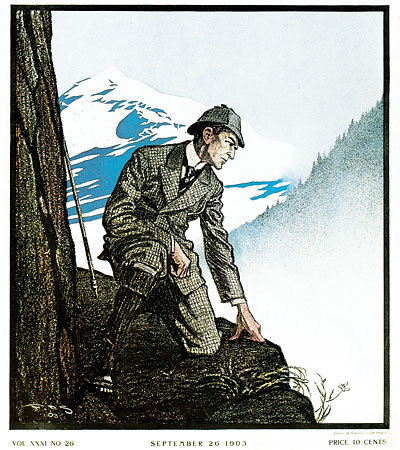
  16. Sherlock Holmes is never described as wearing a deerstalker cap in the stories; however, Sidney Paget (illustrator) often drew him wearing such a hat when undertaking adventures in the country, and it has over time been incorporated into the Sherlock schema.
  17. Neither did Sherlock Holmes ever utter in any of the stories the phrase most popularly attributed to him: "Elementary, my dear Watson." This was a line from an early Sherlock Holmes movie.
  18. Sherlock Holmes' arch-nemesis, Professor Moriarty, is mentioned in only three stories: The Valley of Fear, The Final Problem, and The Empty House. (By the way, Moriarty isn't given a first name, so feel free to invent your own.)
  19. According to various mentions in the stories, Holmes authored papers on (among other things) tobacco ash, footsteps, the influence of trade upon the form of the hand, the dating of old documents, tattoo marks, secret writings (codes), the anatomy of the human ear, and beekeeping. At the time of his retirement, he was working on a comprehensive textbook, The Whole Art of Detection.
  20. Holmes' career extended from 1880 to approximately 1914, with a notable gap between 1892-1894 when, presumed dead in England, he toured Tibet disguised as a Norwegian explorer named Sigerson. The stories themselves were written by Doyle between 1886-1927.
  21. After retiring from his detective work, Sherlock Holmes moved to Sussex to become a beekeeper.
  22. In the stories, Sherlock Holmes is described as inventing a method to positively identify blood and introducing Scotland Yard to the uses of fingerprints in identification. These methods were only just being adopted by Scotland Yard when the stories were written. (The first United Kingdom Fingerprint Bureau was founded by Scotland Yard in 1901; the first tests to positively identify blood were beginning to be adopted by police in the 1880s.) 
  23. Conan Doyle began his professional career as a general practitioner, but later travelled to Vienna to become a specialist in optometry
  24. Oscar Wilde and Conan Doyle once met over dinner with a representative of the American publishing company Lippincott. The publisher commissioned original stories from each author. Wilde's eventual contribution was The Picture of Dorian Gray, while Doyle's submission was The Sign of Four. The two men (Wilde and Doyle) thereafter enjoyed a long acquaintance.
  25. Conan Doyle also numbered Bram Stoker and Harry Houdini among his friends.
  26. The most famous play based on the canon was Sherlock Holmes, which opened in 1899 starring famed actor William Gillette.  In this play, which was written by Gillette with Conan Doyle's blessing, Holmes falls in love with his heroine, Miss Alice Faulker, whose character is based on Irene Adler in A Scandal in Bohemia.   The play was enormously successful; by the end of its run, it had been performed almost 1000 times. (In case you'd like some trivia with your trivia, here's more: When the play ran in London, the role of Billy, Holmes's page, was played by a very young Charlie Chaplin.)
  27. Conan Doyle later wrote a his own Sherlock Holmes play, which he based on the events recounted in The Speckled Band.  It also enjoyed a long and profitable run.
  28. Better-known authors of Sherlock Holmes parodies include Mark Twain (The Double Barrelled Detective Story), P.G. Wodehouse (author of the Jeeves novels), and A.A. Milne (author of the Winnie the Pooh stories)
  29. Conan Doyle and Sir James Barrie (author of Peter Pan) collaborated on their own Sherlock Holmes parody, titled (somewhat self-consciously) The Adventure of the Two Collaborators.  Ironically, this parody was not as popular with the public as parodies and burlesques by other authors.
  30. Conan Doyle was himself involved in investigating several real-life mysteries, and was instrumental in obtaining the release of at least two men who had been falsly imprisoned (George Edalji and Oscar Slater).
  31. When he died, Doyle left an unpublished Holmes story among his papers ("The Man Who Was Wanted") with a note requesting that it not be published, as he felt the quality of the story to be inferiors.  His heirs have (thus far) abided by his request.
  32. Two great artists are responsible for the most well-known Holmes illustrations. Sidney Paget based his portrait on his brother; Frederick Dorr Steele based his portrait of the great detective on William Gillette.
  33. Rex Stout was a serious Sherlock Holmes fan.  His orchid-loving, misanthropic detective Nero Wolfe is deliberately modelled after the great detective.  The producers of the television show House have also acknowledged that the character of Dr. Gregory House is based on Sherlock Holmes (with Dr. Wilson functioning as Dr. Watson). 
  34. Other famous Sherlockians (members of Sherlock organizations) include Franklin Delano Roosevelt, Harry Truman, Dorothy Sayers, Issac Asimov, and Neil Gaiman
  35. To this day, Sherlock fans divide themselves into two camps: "Holmsians" believe that Holmes is a creation of Arthur Conan Doyle's imagination, while "Sherlockians" prefer to play "The Great Game," pretending among themselves that Holmes is a historical personage, Watson his chronicaller, and Conan Doyle the literary agent responsible for placing the  stories in print.
  36. The Baker Street Irregulars, formed in 1834, are a group of Sherlock enthusiasts who publish papers about the great detective and gather once a year at the Algonquin Hotel in New York City for a great feast in the detective's honor. The group accepts only a fixed number of members at any time; new "investitures" are available only upon the death of current members.
  37. Sherlock Holmes appears more frequently in film than any other fictional character but one ... Count Dracula.
  38. Sherlock Holmes is a member of the Royal Society of Chemistry. He was granted an honorary fellowship in 2002.
  39. A historic marker has been erected at Reichenbach Falls.  It reads: "In this fearful place Sherlock Holmes vanquished Professor Moriarty on 4 May 1891."  There is also a Sherlock Holmes museum on the site

6/19/2013

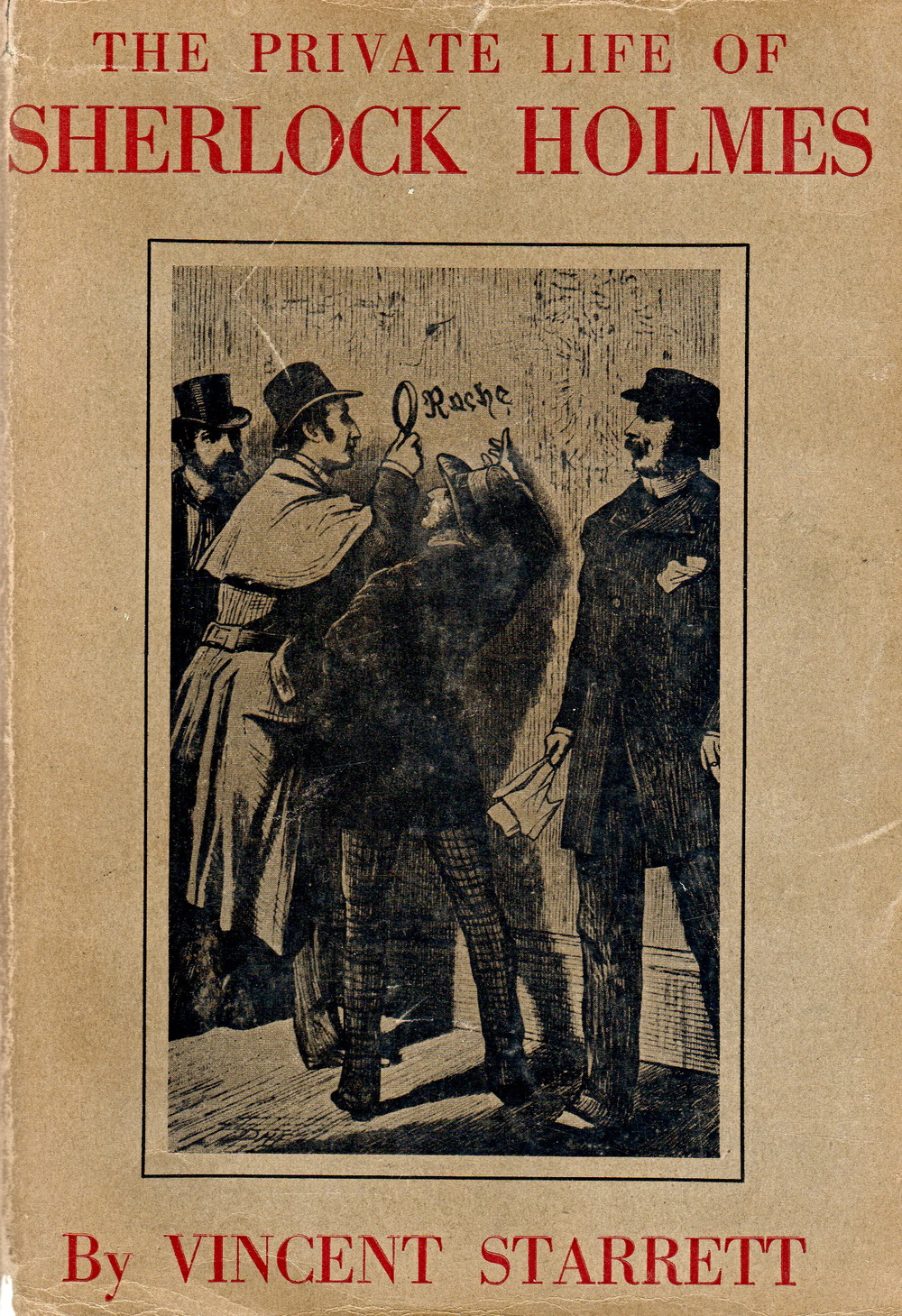
Book Look: The Private Life of Sherlock Holmes, by Vince Starrett

Image result for private life of sherlock starrett


First, a warning: if you aren't a Sherlock Holmes enthusiast*, you might wish to give this a miss. The book is predicated on a basic familiarity/fascination with the canon, the characters, and the author. If you are a fan of the great detective, however, I predict you'll thoroughly enjoy this opportunity to engage in a leisurely discourse with one of the most noted of Sherlockian scholars and admirers. (I say discourse, because this is the kind of book you talk back to - read it with pencil in hand so you can underline, star, and annotate at will!)

(*While Holmes enthusiasts are often eccentric, it is inaccurate to characterize them as "crackpots". Famous members of the most esteemed Sherlock Club - the Baker Street Irregulars - include Franklin Roosevelt, Harry Truman, Isaac Asimov, and an array of scientists, scholars, and businessmen. No shame in numbering oneself among such company!)

Vincent Starett is one of the original "Sherlockians" and this book one of the first to establish the boundaries of "Sherlockian studies". Originally published in the 1940s, this collection of essays includes discussions on the origins of the character, his methods, his (in)famous plummet from Reichenbach Falls & triumphant return, 221B Baker Street (its location and contents), and an especially interesting exploration of Sherlock in books/art/stage. The essays whimsically wander between acknowledging the stories as fiction and treating them as actual historical documents, recording the adventures of an authentic historical personage. Thus we are treated to factual explorations of Conan Doyle's career, Victorian London, and publication details, interspersed with passionate debates about inconsistencies in the stories, lists of monographs purportedly published by Holmes, a discussion of Holmes' biography, an exploration of the nature of the friendship between he and Watson, and speculative lists of "unpublished cases". Starett, a noted journalist, author, and bibliophile back in the day, manages to maintain a reverent, erudite tone without lapsing into campiness. And his knowledge of the canon is wonderfully thorough: every page contained some new insight or item of information that enriched my appreciation of the canon, the gentleman who created them, and - yes - even the people who continue to revere Sherlock and his gaslamp-lit world, "where it is always 1895".

And because this is a 75th anniversary edition, we also get an extensive forward by Ray Betzner exploring the life and adventures of Starrett - a fascinating fellow in his own right - as well as an overview of the evolution of Sherlockian studies.

The book is some 200 pages but a quick, engaging read (depending, that is, on how much time you spend annotating), with a great bibliography of Sherlock-related texts at the end; and don't miss out on an opportunity to assess your own Sherlock cred by tackling the "Final Examination Paper" at the end ... sure to humble even the most avid and well-read Sherlock fans!

5/30/2013

40+ Reasons Why We Read


Frustrated, I once asked a classroom of reluctant readers why it was important that they be able to read.  The answers I got back were demoralizing: "So we can set up our flat screen TVs," "So people don't think we're dumb," and (saddest of all) "because our teachers make us."

I floundered about for a few moments, trying to find the words to express an idea that seemed so obvious to me.  How do even begin to explain trees to someone who has never seen a forest?  Fresh air to someone who has lived their whole lives in a hospital?  How do you convince people who think they know everything that there's a whole world of things they don't know they don't know?

I wish I'd had this list at hand that day.  Maybe I could have changed a few minds.  At the very least, showering them with 40+ reasons ought to at least have earned me the benefit of a doubt.

  1. To experience different places.  Because books are the cheapest vacation you'll find. Want to know what it's like to explore the molten lava fields of Hawaii? Run with wildebeast across the African Sarangheti? Discover the glittering tombs of ancient Egyptian pharoahs?  Climb Everest? Sail the world?  Barter for magic lamps at a Turkish market? All these vacations and more are to be had in the pages of books.
  2. To experience different times.  Until someone figures out this whole parallel universe thing, books are the closest thing to time travel we have. 
    • To experience the past.  The best way to understand history is to vicariously experience history.  Both fiction (historical tales of adventure, romance, or mystery) and non-fiction (histories, diaries) possess the power to make the past come alive.  And you know what they say: those that don't understand history are doomed to repeat it.  Truer words were never spoken.  
    • To experience the present/to stay informed.  Books, newspapers, and periodicals help us keep track of what we need to know about the world around us.  (Because even 500 channels of television can't offer the depth of reportage you get in a single issue of The Washington Post.)
    • To experience the future & explore different futures. There's a reason scientists read science fiction (just because it's a stereotype doesn't mean it's not true): because these works of fiction and non-fiction help us imagine a variety of future worlds and anticipate the challenges that we may eventually face. Think Isaac Asimov speculating about articificial intelligence in I Robot; Michael Crichton exploring the science of genetics in Jurassic Park; Ray Bradbury contemplating the complexities of time travel in "The Sound of Thunder" (the story that introduced us to "the butterfly effect").  Books are like parallel universes, helping us explore the potential - and peril - of the decisions we make now.
  3. To live other lives.  There's a quote plucked from a story by George R.R. Martin: "A reader lives a thousand lives before he dies .... The man who never reads lives only one."  And life is too short to live only once.
    • To hobnob with interesting people.   Want to know how the other half lives? Biographies and autobiographies give us intimate access to the lives of politicians, writers, explorers, and celebrities, all without having to buy a camera or risk being arrested for stalking.
    • To vicariously live other lives.  Reading provide us the opportunity to experience lives wildly different than our own. Because don't we all want to party with Gatsby, sail with Hornblower, and/or hang with Anne of Green Gables?
    • To see the world through new eyes.  Literature gives us the opportunity not just to walk in another man's shoes (as Atticus Finch advocates) but to actually crawl into their minds and experience the world as they experience it. The experience is sometimes fascinating, sometimes disconcerting, but always illuminating.
  4. To learn.  Books are the most patient of teachers, letting us choose what we want to learn, who we wish to teach us, and the rate at which we wish to proceed; best of all, there's never a test at the end.  In the words of the late, great Ray Bradbury: "I spent three days a week for 10 years educating myself in the public library, and it's better than college. People should educate themselves - you can get a complete education for no money. At the end of 10 years, I had read every book in the library and I'd written a thousand stories."
    • To learn more about familiar things.  Call them interests, hobbies, passions, or obsessions; eventually, inevitably, we stumble upon something (usually more than a few somethings) that fascinates us, whether it be World War II, celebrities, cooking, gardening, religion, or sports.  Reading allows us to indulge and inform our obsessions - however functional or dysfunctional.
    • To learn about unfamiliar things.  And then there are the subjects that may not rise to the level of interests, but that for various reasons we must master: how to set up a Bluetooth device, how to calm a crying baby, the side effects of chemotherapy.
    • To satisfy our curiosity. Because life is full of questions, and books contain the answers.
    • To help us understand how much we don't know.  Perhaps the most supreme irony of reading widely is that it dispells ignorance while simultaneously forcing us to acknowledge just how much we don't know. 
  5. To think.
    • To give us the words we need to form our ideas.  Our brains have difficulty comprehending ideas for which we have insufficient language.  The classic example is that Europeans tend to think of snow as ... well, snow.  Whereas the Inuit Indians have 40 different names for snow, which enables them to communicate differences in type and texture that we simply don't perceive.  The more you read, the better equipped you are with mental vocabulary necessary to perceive the world around you.
    • To make us think deeply.  One can navigate through life without thinking deeply (as many reality shows have proven), but what a terrible waste of potential.  Our brains are wired to be able to process enormously complex, abstract, non-literal information, and reading is one avenue that forces us to employ that ability.  Or have we already forgotten Jessica Simpson's infamous display of shallow cognition: "What exactly is 'Chicken of the Sea'? Is it chicken that lives in the sea?"  
    • To make us think critically.  Reading forces us to question, interpret, connect, generalize, analyze, evaluate, and draw conclusions - skills required to lead a full and useful life in this complex world.  
    • To make us see familiar things in new ways.   Because just when you think you know everything you need to know about a topic, a magazine article, treatise or book comes along and makes you realize that you've just been feeling around the tip of the iceberg, without suspecting that 90% of it has been hiding under water. 
    • To build background knowledge.  Brain scientists will tell you that the way our brains learn is by 'linking' new information to information already stored in our memories,  creating 'schemas' - bodies of knowledge.   Think of it like investing: the more money you have, the more you can earn.  Except in this case, the more you already know, the more you are can learn.  Reading is by far the most efficient (not to mention pleasurable) way to build background knowledge.
    • To flex our imagination & improve our creativity.  Professional authors will tell you that the single most important thing they do is READ.  Reading forces us to venture out beyond the bounds of our known world and stimulates us to employ our creativity to fill in the shadowy areas.
  6. To grow.
    • To learn important life lessons.  As children, we are all innocent; gradually, life undertakes our education in such important subjects as love, happiness, and loss.  But life isn't school: sometimes it omits lessons, while other lessons it teaches us over and over (and over) again.  Reading is one way we capture and pass on the lessons necessary to survive adversity and pursue our happiness.  
    • To identify and explore our passions.  Passion is a fabulously fickle thing!  In some people, it is inspired by love, in others, by art or music; in some by religion, in others by math, nature, sports, food, technology, animals, cars ... even, if you believe Orville Reddenbacher, making perfect popcorn.  One can live without passion, but what kind of life is that?  Those who read widely vastly increase the odds of discovering their passion. 
    • To shape our beliefs.  We can believe what we're told to believe, which has proven problematical in the past (think Nazi Germany); or, we can evaluate the world for ourselves and then shape our own beliefs.  Reading is the door through which we access the world of ideas. 
    • To form our characters.  The world is full of role models, but they can't all be your favorite teacher in elementary school or live next door.  Reading allows us to measure the content of our character against others, to weigh our strengths/deficits, and to model our own characters accordingly.  Reading helps us take the measure of our limits ... and our possibilities.
  7. To impress.
    • To gain respect.  In European society, people who are widely read tend to be objects of respect, while those who are poorly read tend to be treated lightly.  Don't believe me? Start dropping Shakespeare quotes and Goethe references into your daily conversations at work and see if your colleagues don't start taking you more seriously.
    • To gain power over others.   Those who understand complex systems - whether they be technical/ scientific, social/cultural, philosophical, political, or financial - also understand how to manipulate those systems.  Was not our recent economic collapse caused by people exploiting their comprehension of legal and financial systems to their own ends?  What resource do these ambitious folk turn to to build the requisite depth of knowledge?  Books, naturally.
    • To avoid being taken advantage of by others.  Because the only way to keep those ambitious folks mentioned above from taking advantage of you, is to know as much about systems as they do.  
  8. To improve.
    • To gain new abilities.  If you want to learn more about a subject that isn't required in high school or offered in college, where are you going to turn?  Books, magazines, textbooks, and manuals.
    • To build vocabulary.  Research has shown that the vocabulary we use in daily conversation is a small subset of the vocabulary we employ when writing.  Therefore, if you want to build your vocabulary, it's much more efficient to read than to converse.
    • To improve our communications skills.   Just because you have a mouth and a tongue doesn't mean you know how to communicate effectively.  True story: a family member of mine had to turn down two brilliant scientists for a senior position because they lacked the vocabulary and skill to effectively communicate their ideas.   The #1 way to build writing (and oral communication) skills?  Reading and studying the work of effective writers.
  9. To feel.
    • To experience deep emotions.  Let's face it - most of us aren't destined to live lives of grand passion and adventure.  But literature allows us to experience every imaginable extreme of emotion: elation, despair, pride, fear, courage, passion, rage, vengence, hatred ... and, yes, even true love. 
    • To experience unfamiliar emotions.  Thanks to books, we don't have to actually venture forth on a whaling ship to understand the gnawing bitterness of revenge; we don't have to stab ourselves to death at the tomb of our deceased beloved to experience the tragedy of doomed love; and we don't have to have to go through life with a scarlet A sewn over our hearts to experience the frustration and humiliation of Hester Prynne. 
  10. To empathize.
    • To understand the viewpoints of others.  Vulcan mind-melding aside, reading is one of the most powerful tools we possess to help us "meld" with other minds and experience the world as others experience it.
    • To develop empathy/tolerance towards others.  Only once we understand how others think and feel, we can begin to develop empathy/tolerance towards those who think differently than ourselves.
  11. To cope
    • To escape from reality.  Television has to some extent taken over this function, but when it comes to choice, even 500 channels can't hold a candle to a library full of reading material.  Absorbing yourself in a book is a splendid way to forget your cares, at least for the space of a chapter or two.
    • To be inspired/to hope.  Stories about other people overcoming difficulties and/or working to achieve their dreams possess the ability to inspire us to work towards achieving our own dreams.  
    • To know that we are not alone.  I'd explain, but author James Baldwin does so much more passionately than I ever could:  “You think your pain and your heartbreak are unprecedented in the history of the world, but then you read. It was books that taught me that the things that tormented me most were the very things that connected me with all the people who were alive, or who had ever been alive.”
  12. To connect us to our pasts, our communities, and our world.
    • To understand how we are connected to myth/legend/religion.  Scholars tell us that myths/legends endure because they tell us who we are and explain our role in the world. (Long before science we had titans; long before Ginger vs. Mary Anne, we had Artemis vs. Aphrodite.)   Fittingly, they are among the first stories ever set in print, where they remain to this day, still telling us who we are, still explaining our role in the world.
    • To recapture our childhood.  Time machines may one day be able to take us back in time, but books have the power actually to slough away the years of our lives until we are children again.  Rereading books that you first read as a child is particularly potent magic.
    • To explore great themes.  Stories identified as "classics" are classics for a reason: they identify and explore the great universal themes - love, hate, desire, fear - in ways that are uniquely empathetic, utilizing language that is uniquely approachable.  Like myths, they help us understand who we are; more to the point, they help us identify the paths that are open to us so that we can choose which to follow. 
    • To explore great ideas.  Every generation is blessed with its own scientists, philosophers, and visionaries, but we must turn to books to access the great ideas of past generations.
    • To share a common experience with strangers.  I recently read a quote that went something like this: "Based on the contents of your library, I can tell we're going to be great friends."  Books not only tell us who we are (Oscar Wilde once said "It is what you read when you don't have to that determines what you will be when you can't help it"), but they connect us with others who share our values and passions.
  13. To enjoy.
    • To enjoy a good story, well told.  Because, hey, we're human, which means we love a good story: how else were we going to while away all those long winter nights spent huddling in caves?  In the ensuing thousands of years we may have left the campfire behind, but our delight in a good story well told - especially if the story involves one of our favorite themes: good triumphant over evil, or love triumphant over obstacles - remains wholly unspoiled.  (For those of you thinking, "If I want a good story, I'll go see a movie!" you may wish to consider that many of the most stirring movies started as books.)
    • To delight in the music of words.  Speaking of human evolution, scientists conjecture that our brains are hardwired to identify patterns of sound; indeed, it is this ability to identify patterns of sound that has enabled us to develop spoken language.  Today, this primal love of vocal patterns expresses itself in our universal appreciation for music and poetry (especially poetry with rhyme and meter).  So go read a poem and get in touch with your inner caveman!

5/19/2013

Book Look: Book By Book, by Michael Dirda


You've heard the aphorism: "Based solely on the contents of your library, I knew we were going to be the best of friends"? Michael Dirda's a Pulitzer Prize winning Book Critic who I've never met except through his frequent contributions to the Washington Post's Book World, but based on this short memoir, we'd definitely hit it off.

Reading this felt like hanging out with a group of old college friends, exchanging ideas and anecdotes about life, religion, art, and literature. Not in a wine and cheese way, but in a beer and chips way, with everyone interrupting each other, quotes from famous books/authors offered as supporting evidence, raised voices, lots of gesticulating, and plenty of anecdotes and digressions. ("They made us read Mary Wollencraft in college - ugh!"; "I went from Nancy Drew straight to Agatha Christie, but my next stop definitely wasn't Crime & Punishment!";"Where's Poe? How can you compile a list of the greatest horror stories without a single Poe?")

The book is a collection of reflective essays, quotes, and lists, and is definitely best read with a pencil at hand, because half the fun is interacting with the text: agreeing, disagreeing, making connections, marking off books already read and books to add to your reading list, etc. Only alert I'll issue to potential readers is that the author does presume a good grounding in European/American humanities. If you've attended a decent US/European liberal arts college or are an autodidact, however, you should be fine.

If you're ever in Virginia, Michael Dirda, my college buddies and will have a beer standing by with your name on it!

5/06/2013

35+ Ways to Promote Reading in Schools

The middle school where I teach draw students from neighborhoods where literacy is not necessarily a priority - at least not as high a priority as finding enough money to pay rent, avoiding drugs and gangs, eating at least one meal a day, and trying to stay out of trouble.  For these students, reading logs are a farce, and offering them a pizza if they read 20 books is ridiculous.  Much, much, much more is required to instill in these students an intrinsic (rather than extrinsic) motivation to read. 

The good news is that all humans have an inate love of storytelling.  Once kids start reading, they will almost inevitably get hooked.  The bad news is that with so many other challenges facing them -  challenges which often include poor foundational literacy skills, poor cultural literacy, poor early education, learning disabilities, and literacy-poor home environments - convincing students that reading is worth the effort can be a hard sell.  It takes more than one good English teacher, more than one free book ... I believe that it takes a whole school, from the custodians on up, with wrap-around literacy emphasis, to make this happen. 

The following list is stuffed with every suggestion I've researched, implemented or contemplated to help motivate literacy and reading in at-risk populations (though I'm sure they'd work with readers from every socio-economic background).  Because we need to stop thinking about reading as the problem and start thinking about reading as the solution
  1. Provide access to books
    1. Stock your library with books at a variety of reading levels, making sure that books at lower reading levels have cover art and content that are appropriate for the students' grade level.  (No student wants to be seen reading a "baby book".)
    2. Make sure you offer a variety of sizes and styles of reading material: long books, short books, books with pictures, books without pictures, large print, small print ....  Students look for books that fit not merely their interests, but also certain physical preferences. 
    3. Have books available in the front office, the lunch room, the clinic, the hallways, the principal's office ... everywhere!  Establish a system that makes checking them out either painless or (if possible) unnecessary.
    4. Stock a wide selection of "easy to read" versions of classic literature. Kids who have read and enjoyed The Hound of the Baskervilles (or The Prince and the Pauper, or Dracula) in easy-to-read or comic book version will be more likely to attempt the original version, and to persevere through difficulties. (Moreover, students gain pride and self-confidence from the knowledge that they've read a "classic".)
  2. Let kids read what they want to read! 
    1. If a student wants to read material that's too "easy" for them, let them.  The experience will help them build confidence; in time, it's likely they'll crave something more filling
    2. If a student wants to read material that's too "difficult" for them, don't discourage them!  Do, however, help them out by previewing the story* (and key vocabulary if appropriate) so they have an idea of what to expect. (*Give them plot summaries, or encourage them to read reviews by other readers.)
    3. Don't force students to read books that are "good" for them.  There will be plenty of time for that later.
    4. If students don't want to read books, let them read magazines ... graphic novels ... comic books ... whatever!  Over time, it's often possible to leverage a student hooked on Sports Illustrated for Kids to books about sports.
  3. Expose students to a wide variety of books
    1. Open classes with a short, highly engaging read-alouds from books at the students' reading level - just enough to whet their appetites.  I love stopping in the middle of a dramatic moment ... drives the students crazy, but don't they cue up afterwards for copies of the book!
    2. In your classroom, sort at least some books by genre, as reluctant readers are often more willing to take a chance on a new book if they're comfortable with the genre.  Meanwhile, devise a system to encourage or help students expand beyond their preferred genres.
    3. Devote a bulletin board to genres.  List 4-5 high-interest books representing the genre.  (Resist the urge to include only "worthy" books - readability and entertainment value are imperative in building interest and trust!) 
    4. Create an "if you liked ____, then try ______" bulletin board or wall. Provide pre-printed cards students can fill out & thumbtacs onto the board with their recommendations.
  4. Make reading interactive
    1. Have students maintain lists of their favorite books.  Create opportunities for them to talk about their favorite books with classmates.  One idea: match students who list the same books and have them work on a project together.  Or, match students with dissimilar books and challenge them to identify as many similarities as possible!
    2. Create a book review blog or wiki where student can post book reviews and/or comment on the reviews of others.
    3. Engage students in conversation about the books they are reading.  Your interest in the book with validate theirs.  Ask intelligent, open-ended questions that will require them to think about what they've read - especially questions that require them to relate the books to their own lives
    4. Use your school's morning announcements as a chance to air "book trailers."  Many publishers of children's books provide "book trailers" online that are especially designed to build interest in their titles.  If appropriate, you may wish to intermingle these with reviews created by the students themselves, perhaps using simple tools like Windows Movie Maker.
    5. Sponsor reading groups for wide variety of abilities and interests. Squish them into your school day: during lunch, before/after school.  These book groups don't have to be led by teachers ... in fact, students may find them even more enjoyable if they are led by beloved custodians, lunch ladies, secretaries, or members of the community.  The idea isn't to teach, but to engage the students in lively discussion and model enthusiasm.  
    6. Book reviews are fine, but often not an activity that appeals to struggling readers, as the same students are often struggling writers as well.  Instead, encourage students to create projects or games related to their books.  My students enjoy creating games because then they get to play them with their friends, who in turn develop enthusiasm for the stories ... talk about a win-win!
    7. Find ways to recognize and reinforce reluctant readers (without embarassing them).
  5. Teach the things that good readers do
    1. Model for students how you interact with text by reading aloud and stopping frequently to share with them your own questions/predictions/opinions/reactions.
    2. Teach students how to visualize text
    3. Teach students how to properly preview a text - how to read the back cover, how to draw conclusions from the title and picture, how to use the information on the inside flap, etc.
    4. Teach students how to search for books in the library - don't just assume they already know how!
  6. Make reading authentic
    1. Teaching reading not just as a skill but as cultural literacy! Show excerpts from The Simpsons, Disney movies, and other shows/movies that reference classic literature.
    2. Teach reading not just as a skill but as a content area. Talk about how authors use characters, conflict, and plot to create themes that relate to real life.
    3. Sponsor "book movie" afternoons, where kids get to watch the movie versions of famous books. Make sure to have many copies of the book available that afternoon so studnets can leave with them while enthusiasm is fresh
    4. Have students read aloud to students younger than themselves.
    5. Encourage students to post their book reviews on popular websites such as Good Reads.
  7. Make reading ubiquitous
    1. Post "pro-literacy" (quotes about the benefits of reading) all around the school.
    2. Make sure students are reading in all their classes, not just English. To the extent possible, incorporate book groups and literature circles in all your subject areas.
    3. Encourage students to read independently throughout the day - when waiting for class to begin, when they finish their work early, during lunch ....
  8. Make reading glamorous
    1. Treat authors like celebrities. Discuss them. Do book reports about them. Participate in online discussions with them. Visit them when they arrive in town for book tours.
    2. Treat book openings like movie openings. Count down the days until sequels to popular books are released. Have book release parties.
  9. Provide reading role models
    1. Have teachers and staff post info on what they are reading on posters next to their doors. Encourage them to discuss their books with students.
    2. Let students see you reading on your off-time. Talk about how you are looking forward to reading when you get off work.
    3. Ask celebrities to recommend their favorite books. Maintain lists.